Why Everything Costs 15% More Lately—and How the Middle Class Can Beat Inflation
Have you taken a close look at your credit card statement or bank account after a routine weekend grocery run or errand trip lately?
Whether you are grabbing a quick morning coffee at your local deli, paying for a monthly train commute, or filling up a cart at the supermarket, it feels like the price tag on almost everything has jumped by 15% or more over a short period.
If you feel like your hard-earned paycheck doesn’t stretch as far as it used to, you are not imagining things.
What the Economic Data Tells Us
While price hikes feel sudden when you check out at the register, economic data shows how relentless compounding price increases have been over time.
According to regional data from the U.S. Bureau of Labor Statistics (BLS):
- Annual Price Indexes: Over recent years, consumer price indexes expanded steadily between 3.0% and over 4.5% annually across major metropolitan areas.
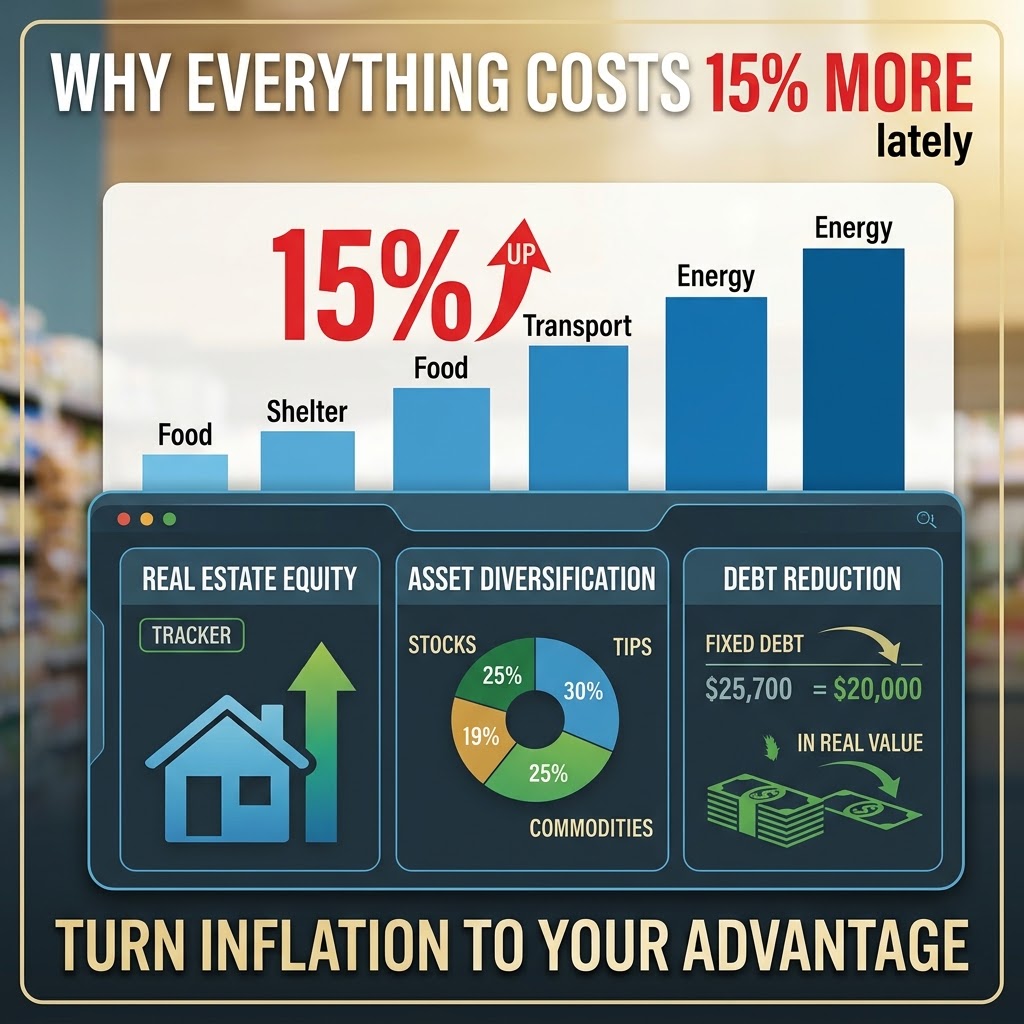
- The Cumulative Impact: When you compound those figures across core expenses like food, electricity, and housing, everyday prices have risen roughly 12% to 15% overall over a three-year span.
- Everyday Essentials Hit Harder: Key categories impact middle-class families even harder—transportation, motor fuels, and home shelter experienced localized spikes that pushed out-of-pocket costs well beyond headline figures.
So when your weekly routines feel 15% more expensive than they used to, your math is right on target.
What Is Inflation? The Tale of the Village Baker
To understand why prices go up and where all this extra currency comes from, consider a simplified economic story.
Imagine a small, isolated village with only one bakery. The baker can produce exactly 100 loaves of bread per day, and the villagers use gold coins as currency.
One day, a massive stash of new gold coins is discovered and distributed equally to everyone in the village overnight.
At first, the villagers are thrilled! They believe they are rich and can finally buy as much bread as they want. However, actual economic output has not changed—the baker can still only produce 100 loaves a day.
The next morning, villagers line up outside the bakery with pockets full of gold, eager to buy 10 or 20 loaves each. Realizing demand is massive while supply is fixed, the baker raises her prices tenfold to manage the excess demand.
Suddenly, those hard-earned gold coins the villagers had saved in their drawers buy only a fraction of what they used to. Even though everyone had more coins, no new wealth or goods were actually created—so the purchasing power of every existing coin was simply diluted.
Furthermore, the landowner where the bakery sits notices the change and says: “Since you are collecting ten times more coins for your bread, your property rent is going up ten times as well.”
Bridging the Story to Real Life: Money Supply and Government Spending
In our village parable, money suddenly appeared out of nowhere. In the real world, central banks and governments expand the money supply by issuing new currency, lowering interest rates, or running large budget deficits.
When central authorities expand the circulating currency faster than the economy grows its output of actual goods and services, each individual dollar buys less over time.
In economics, this dynamic creates a phenomenon known as seigniorage—often described as an invisible tax:
- Rather than raising direct taxes, new currency is introduced into the financial system to fund public spending.
- The indirect cost is absorbed by middle-class citizens, as the purchasing power of their existing cash savings quietly erodes.
Who Wins and Who Loses in an Inflationary Economy?
Inflation penalizes cash holders and fixed-wage earners, but asset owners and fixed-rate debtors often benefit:
- Physical Assets Appreciate: Real estate, land, commodities, and corporate equities tend to adjust their nominal dollar valuations upward alongside expanding currency supplies.
- Fixed Debt Shrinks in Real Terms: If a homeowner holds a fixed-rate mortgage, the nominal dollar amount of that debt stays locked in place. As wages and property values rise with inflation, that debt becomes easier to pay off using lower-value dollars.
How Middle-Class Families Can Leverage Inflation
For middle-class households—where property taxes, utilities, and daily living costs take up a significant portion of monthly income—holding too much uninvested cash can cause your wealth to erode over time.
To protect your financial security, consider shifting your mindset from being a consumer absorbing higher costs to an investor leveraging productive assets:
1. Own Productive and Real Assets
Avoid leaving long-term wealth in low-yield savings accounts that fail to keep pace with price indexes. Diversifying into equities, real estate, or broad-market index funds allows you to own underlying businesses that can adjust their pricing power during high-inflation periods.
2. Capitalize on Fixed-Rate Liabilities
Inflation rewards borrowers who hold long-term, fixed-rate debt. Holding a 30-year fixed-rate mortgage on real estate allows inflation to steadily reduce the real burden of that debt over time while property equity builds.
3. Focus on Inflation-Hedged Income
Structuring a portfolio with dividend-growth stocks and Treasury Inflation-Protected Securities (TIPS) can help ensure your income streams keep up with rising living expenses over the long haul.
Key Takeaway: Inflation is a permanent feature of modern monetary systems, but it doesn’t have to undermine your financial goals. By organizing your assets around fixed liabilities and inflation-resilient investments, you can better protect your family’s purchasing power.
By Irene | Money Bloom Daily
Financial Disclaimer
Disclaimer: The information provided in this article is for educational and informational purposes only and does not constitute financial, investment, legal, or tax advice. The opinions expressed are solely those of the author. Investing in financial assets involves risk, including potential loss of principal. Always consult with a licensed fiduciary or certified financial planner before making investment decisions.
Leave a Reply