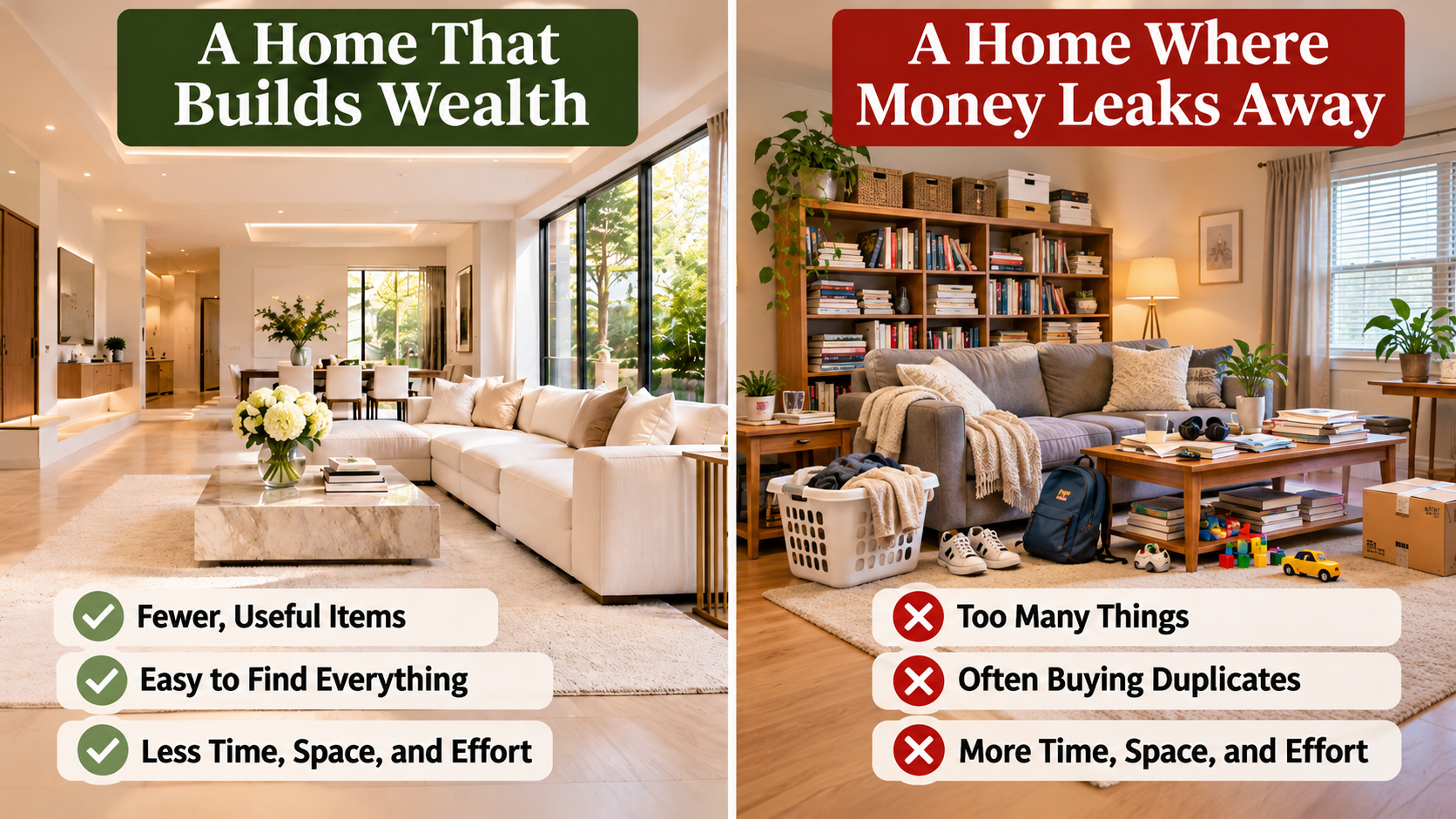
What If Building Wealth Starts Right at Home?
The surprising connection between our belongings, spending habits, and the money we manage to save.
Have you ever opened your kitchen cabinet and discovered three bottles of the same sauce?
Or spent 15 minutes looking for something, given up, and ordered another one on Amazon?
Then, of course, the original shows up two days later.
I think most of us have been there.
Between work, kids, grocery shopping, laundry, and everything else that comes with everyday life, keeping track of what we own isn’t always easy.
And sometimes, buying something new feels easier than finding what we already have.
But recently, I came across a book that made me look at my home differently.
Not because I suddenly wanted to become a minimalist.
And definitely not because I wanted to spend my weekends organizing every drawer.
It made me wonder about something much more interesting.
What if saving money isn’t always about giving things up? What if it starts with making better use of what we already have?
The Japanese Woman Who Made Me Think Differently About Money
The author is Shimomura Shihomi (下村志保美), a Japanese organizing expert with an interesting career story.
She didn’t start out organizing people’s homes.
She previously worked as an English instructor and assisted a fund manager at an investment advisory firm. She also spent several years living in Qatar.
After returning to Japan, she helped a friend organize her home.
Her friend was so happy with the result that Shimomura realized something she naturally enjoyed doing could actually help other people.
In 2014, she started her organizing business, PRECIOUS DAYS.
Since then, she has worked on thousands of home and workplace organizing projects.
What caught my attention wasn’t simply her ability to make a room look beautiful.
It was her perspective on the relationship between the things we own and the way we manage money.
Her Japanese book is titled 『「お金が貯まる家」にはものが少ない』, which roughly translates to Homes That Accumulate Wealth Have Fewer Things.
The Korean edition has an even more intriguing title: 『돈이 쌓이는 집, 돈이 새는 집』, meaning A Home Where Money Accumulates, a Home Where Money Leaks Away.
I loved that title.
Because we spend so much time thinking about how to earn more money, invest better, and save for the future.
But how often do we think about the money tied up in the things sitting around our homes?
The unopened purchases.
The clothes we forgot we owned.
The appliances we bought with great intentions but rarely use.
None of these things seems particularly expensive on its own.
But together, they can reveal habits worth paying attention to.
The Three Thieves Hiding in Our Homes
One way I like to think about the hidden costs of clutter is through three little thieves.
The Time Thief. The Space Thief. And the Effort Thief.
They’re not actual thieves, of course.
They’re the small inconveniences that come from having more belongings than we can comfortably manage.
And the funny thing is, we often don’t notice them because they’ve become part of our daily routines.
1. The Time Thief: Where Did I Put That?
Picture a typical weekday morning.
You’re getting ready to leave.
Someone can’t find their shoes.
Someone else is looking for a charger.
And the umbrella you bought last month has mysteriously disappeared.
You know it’s somewhere in the house.
You just have no idea where.
So you start searching.
You check the same drawer three times, hoping it will magically appear.
Eventually, you find it.
Or you give up and buy another one.
Now imagine spending just 15 minutes looking for misplaced things four times a week.
That’s one hour every week.
Over a year, that’s 52 hours spent searching for things you already own.
More than two full days!
I don’t know about you, but I can think of much better ways to spend those two days.
Here’s a little experiment worth trying.
Tomorrow morning, open your shoe closet and see whether you can find the pair you want within 20 seconds.
If you can, wonderful.
If not, maybe your shoe closet could use a little attention.
You might even rediscover a pair you completely forgot about.
And instead of buying something new, you get to enjoy something you already own.
That’s a small win for both your morning and your wallet.
2. The Space Thief: Your Most Expensive Storage Room
This idea really stayed with me.
Especially living on Long Island, where housing costs are anything but small.
We work incredibly hard to afford our homes.
We pay mortgages, property taxes, insurance, and maintenance.
But have you ever thought about how much of that expensive space we’re using simply to store things?
Let’s imagine a 2,000-square-foot house worth $800,000.
There’s a 150-square-foot room filled with boxes, unused furniture, old appliances, and things we might need someday.
That room represents 7.5% of the home’s floor area.
If we apply that percentage to the home’s value, we’re talking about approximately $60,000 worth of floor space.
Of course, this is just an illustration. A room doesn’t have its own separate resale value based on square footage alone.
But it certainly makes you think.
What if that room could become something you actually enjoy?
A small home office.
A reading room.
A place for the kids to study.
Or simply a quiet space where you can relax.
And what about the guest bedroom?
Maybe you love having a beautiful room ready for visiting family.
There’s nothing wrong with that.
But if guests stay only once or twice a year, perhaps the room could serve another purpose during the rest of the year.
Sometimes we dream about moving into a bigger house because we need more space.
But what if the space we’re looking for is already inside the home we own?
Before buying another piece of furniture or another storage container, it might be worth asking whether we really need more storage—or simply fewer things to store.
3. The Effort Thief: Why Does Cleaning Take So Much Work?
Have you ever spent 20 minutes getting ready to vacuum?
First, you move the shoes.
Then the baskets.
Then the toys.
Then the little things that somehow ended up on the floor.
Finally, you’re ready to clean.
And next week, you do it all over again.
I particularly like the robot vacuum example.
A robot vacuum is supposed to make life easier.
But what happens when it gets stuck under furniture, tangled in cords, or trapped between things on the floor?
You end up rescuing it every few minutes.
Not exactly the time-saving experience you imagined.
Here’s a fun question:
Can your robot vacuum move around your living room without getting stuck?
If not, perhaps there’s an opportunity to make the space work a little better.
The same thing happens in our bathrooms and laundry rooms.
We buy shampoo because it’s on sale.
Then another bottle because we forgot we already had some.
Before we know it, there’s enough shampoo in the cabinet to last several months.
Buying in bulk can absolutely save money when the price is right and we know we’ll use everything.
But buying more than we need isn’t always a bargain.
Every extra item needs somewhere to live.
And every time we need something, we have to remember where we put it.
The goal isn’t to have a perfectly organized home. It’s to make everyday life a little easier.
The Umbrella Problem: A Small Habit That Adds Up
Let’s talk about umbrellas.
How many do you have?
One near the front door.
Another in the car.
A couple in the closet.
And maybe a few more you bought on rainy days because you forgot to bring one.
Each umbrella might cost only $10 or $15.
Not a huge expense.
But I think the interesting part isn’t the umbrella itself.
It’s the habit behind it.
We buy something.
We bring it home.
We forget where we put it.
And eventually, we buy another one.
The same thing can happen with phone chargers, kitchen utensils, school supplies, cleaning products, and groceries.
Have you ever bought another bottle of soy sauce because you couldn’t remember whether you had any left?
Then you come home and discover two unopened bottles in the pantry.
It happens.
But imagine how much easier shopping could become if we knew exactly what we already had.
Maybe we don’t need a complicated organization system.
Maybe we just need to give everyday items a regular place.
An umbrella near the door.
Chargers in one drawer.
Household supplies stored where we can see them.
Sometimes the simplest habits are the most useful.
A Closet Full of Clothes Can Be an Opportunity
Have you ever stood in front of a closet full of clothes and thought:
I have nothing to wear.
I think most of us have experienced that.
Sometimes we buy something because it’s on sale.
Other times, we love how it looks in the store, but once we get home, it doesn’t feel quite right.
So we keep it, hoping we’ll wear it someday.
And somehow, we end up shopping again.
One idea I really like from the book is making sure we can actually see the clothes we own.
When everything is buried in piles, it’s easy to forget what’s already there.
But when our clothes are visible and organized, we might rediscover pieces we love.
Maybe we already have the perfect sweater.
Or maybe we don’t need another pair of black pants after all.
And the next time we’re shopping, perhaps we can be a little more selective.
Instead of buying something that’s almost right, we can wait for something we genuinely enjoy wearing.
The best deal isn’t always the biggest discount. Sometimes it’s realizing we already have exactly what we need.
The Purchase You Didn’t Make Is Money You Still Have
Here’s an idea I want to remember the next time I’m shopping.
Imagine finding a beautiful jacket for $150.
You try it on.
You like it.
But you’re not completely sure.
So you decide to wait.
A few days later, you realize you don’t really need it.
Normally, walking away from a purchase doesn’t feel especially exciting.
There’s no package arriving tomorrow.
Nothing new to hang in your closet.
But think about what happened.
You kept $150 in your bank account.
We get excited when something is 30% off.
But perhaps we should also celebrate the purchases we decide not to make.
Because every dollar we don’t spend unnecessarily is a dollar we can put toward something more meaningful.
A family vacation.
Our children’s future.
An investment account.
Or simply the peace of mind that comes from having more savings.
Maybe Our Finances Need a Little Decluttering, Too
We collect store rewards, coupons, memberships, and credit cards because we want to save money.
And sometimes they really do help.
But only when we can manage them.
A coupon is useful when it reduces the cost of something we already planned to buy.
It’s less helpful when it encourages us to purchase something unnecessary.
And if our spending is spread across several credit cards without a clear tracking system, it can become difficult to understand where our money goes.
Some couples find it easier to use one primary credit-card account with two authorized users for shared household expenses.
Others prefer multiple cards and a budgeting app that brings everything together.
There’s no perfect number of cards for everyone, and closing existing accounts can affect credit scores.
What matters is having a system that works.
Managing money should feel clear and manageable, not like another complicated household chore.
But What About Kids and Sentimental Things?
Of course, all of this sounds easier when you’re imagining a perfectly organized house with empty countertops.
Real family life looks a little different.
There are backpacks.
Sports equipment.
School projects.
Musical instruments.
And random little things that somehow become incredibly important to our children.
Then there are the sentimental items.
Your child’s first pair of shoes.
A handmade Mother’s Day card.
Old family photographs.
Things that might mean nothing to someone else but mean everything to you.
I wouldn’t want to get rid of those things just to have a tidier house.
And I don’t think that’s the point.
A home should hold memories.
The goal isn’t to own as little as possible.
It’s to make room for the things that matter most.
If something has sentimental value and you want to keep it for another 15 or 20 years, keep it.
Give it a meaningful place.
But if you’re holding onto something simply because you feel guilty letting it go, perhaps it’s worth reconsidering.
Someone else might be able to enjoy it.
And you might enjoy the extra space.
What Could Small Changes Mean for Your Savings?
Let’s imagine a family starts paying a little more attention to what they already own.
They stop buying duplicate groceries.
They become more selective about clothing.
They wait before making impulse purchases.
And they use household products they already have.
Maybe those changes save $175 a month.
| Small change | Monthly savings |
|---|---|
| Avoiding duplicate groceries | $40 |
| Buying fewer unused clothes | $50 |
| Reducing impulse purchases | $60 |
| Using existing household products | $25 |
| Total | $175 |
That’s $2,100 a year.
Now imagine investing that $175 every month for 20 years.
At a hypothetical 7% annual return, compounded monthly, it could grow to approximately $91,000.
Of course, investment returns aren’t guaranteed, and actual results will vary. This illustration excludes taxes and fees.
But I find that possibility encouraging.
Because these changes don’t require a higher salary or a completely different lifestyle.
They begin with paying a little more attention to what we already have.
And beyond the financial savings, we might gain something equally valuable.
More time.
More usable space.
And fewer little frustrations throughout the day.
This Weekend, Rediscover Your Home
Here’s something I’d love you to try.
Choose one small area of your home.
Maybe your shoe closet.
Your kitchen pantry.
Your bathroom cabinet.
Or the guest bedroom that gets used only once or twice a year.
Don’t worry about making everything perfect.
Just spend 15 minutes looking around.
You might find something you forgot you owned.
You might discover that you already have enough shampoo for the next three months.
Or you might clear enough space to enjoy a room in a completely new way.
And before your next purchase, ask yourself:
Do I really need this, or do I already have something that works just as well?
Every small decision is an opportunity to save money, reclaim time, and make your home more comfortable.
The Bottom Line: More Room for What Matters
We spend so much time thinking about how to build wealth.
How to earn more.
How to invest better.
How to save for retirement and our children’s future.
But this book reminded me that building wealth isn’t only about what we add to our bank accounts.
Sometimes it’s also about what we choose not to bring into our homes.
The things we don’t buy.
The duplicates we avoid.
The time we get back.
And the space we rediscover.
A beautiful home doesn’t have to be perfectly organized.
A financially healthy family doesn’t have to live with fewer possessions than everyone else.
But when we become more intentional about what we own, we can create something valuable.
More space to enjoy our homes. More time with our families. And more money for the future we’re working toward.
Maybe saving money doesn’t have to begin with giving something up.
Maybe it can begin with appreciating everything we already have.
Book acknowledgment: This article was inspired by the Japanese book 『「お金が貯まる家」にはものが少ない』 by Shimomura Shihomi (下村志保美), published in Korean as 『돈이 쌓이는 집, 돈이 새는 집』. The examples, reflections, and financial calculations are original Money Bloom Daily commentary. The three-thieves framework is used as an interpretation of the book’s themes rather than a verified direct quotation.
Financial illustrations are hypothetical and provided for educational purposes only.
Leave a Reply