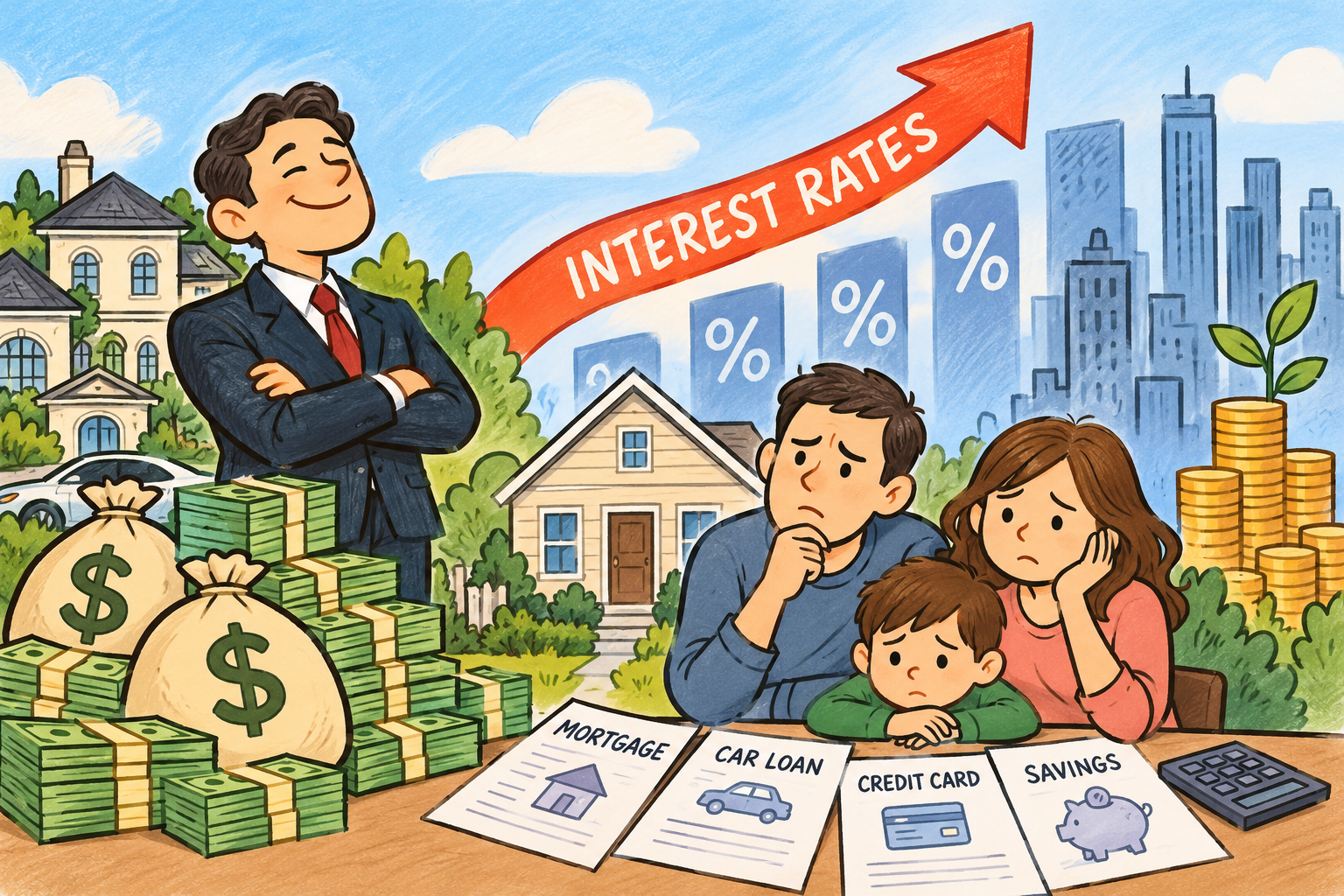
When my family was house hunting, I realized that the price of a home was only part of the decision. The interest rate mattered just as much. A higher rate could make the monthly payment so much bigger that a home we could afford at one rate might feel out of reach at another.
Back then, I mostly thought about how rates affected people trying to buy a home. Now I see that the same high rates can affect people in very different ways. A person with cash may have more choices. A family with credit-card debt may have a harder time keeping up. And someone with savings may earn more interest, depending on the account.
How do high rates affect homebuyers?
When mortgage rates rise, borrowing for a home usually costs more each month. Some buyers may look for a less expensive home, offer less, or wait before buying. That can put downward pressure on home prices.
Here is a simple example for a $400,000, 30-year mortgage. At 3%, principal and interest would be about $1,686 a month. At 7.40%, it would be about $2,770 a month. These estimates do not include property taxes, homeowners insurance, or other costs.
| $400,000 mortgage for 30 years | At 3% | At 7.40% |
|---|---|---|
| Monthly principal and interest | About $1,686 | About $2,770 |
| Total interest over 30 years | About $207,110 | About $597,027 |
Freddie Mac reported that the average 30-year fixed mortgage rate was 7.40% on October 15, 2026. Each borrower’s offer can be different. Source: Freddie Mac
Higher rates can put pressure on home prices, but they do not always make prices fall. The number of homes for sale matters too. Some homeowners with older, lower-rate mortgages may decide not to move because their next mortgage would cost more. In July 2026, U.S. home prices were 2.6% higher than a year earlier, according to the Federal Housing Finance Agency. Source: FHFA
Can people with cash benefit?
A buyer who pays cash does not need a mortgage, so a high mortgage rate does not raise their borrowing cost. If fewer buyers are competing, a cash buyer may have more room to negotiate. If a seller needs to sell and buyers have pulled back, that buyer might find a lower price.
But a discount is not guaranteed. Prices still depend on location, condition, supply, and demand. A cash buyer also has to think about property taxes, insurance, repairs, and the cost of putting a lot of money into one home.
This is one way wealth can create more choices. A person with plenty of cash may be able to wait or make an offer without depending on a bank loan. A buyer who needs a mortgage has fewer choices when the monthly payment gets too high.
What happens to savings and credit-card debt?
Higher rates may help people earn more interest if their savings account pays a competitive rate. For example, at a hypothetical 4% annual rate, $10,000 would earn about $400 before taxes in one year. A $100,000 balance would earn about $4,000. Anyone with savings can benefit, but a larger balance earns more dollars.
Credit-card debt can work the other way. Many credit-card APRs are variable, which means the rate can change with an index such as the prime rate. If the APR rises, interest charges on an unpaid balance can rise too. Source: Consumer Financial Protection Bureau
For a simple illustration, a $5,000 balance at a 24% APR would accrue roughly $100 in interest in one month if the balance stayed the same. The actual charge depends on the card’s terms, daily balance, and payments. When someone is already carrying debt, that interest can leave less money for groceries, bills, or savings.
What about car loans?
I was not sure whether car loans change when interest rates rise. The Consumer Financial Protection Bureau says most auto loans are fixed-rate, so the rate on an existing loan usually stays the same. But someone shopping for a new car loan may be offered a higher rate when borrowing costs are high. Source: CFPB
5 Smart Money Moves Families Can Make When Interest Rates Are High
We cannot control interest rates, but we can control some of the financial decisions we make. When borrowing becomes expensive, I think families should focus on two things: reducing the interest they pay and increasing the interest they earn.
1. Pay off high-interest credit card debt first
Credit card debt can become especially expensive when interest rates are high. For example, a $5,000 balance at 24% APR would cost roughly $1,200 in interest over a year if the balance stayed at $5,000. That’s about $100 a month that could otherwise go toward groceries, savings, or family activities. Actual charges depend on daily balances and payments.
What you can do: Check each card’s APR. Make at least the minimum payment on every card, then put any extra money toward the highest-rate balance. If considering a 0% balance transfer, compare fees and make sure you can pay it off before the promotional rate ends. Keep some cash available for emergencies.
2. Make your savings earn more interest
One advantage of higher rates is that savings accounts may offer better returns, but not all banks pay the same rate.
| $20,000 in savings for one year | Interest earned before taxes |
|---|---|
| Traditional account at 0.1% | About $20 |
| High-yield account at 4% | About $800 |
| Potential difference | About $780 |
These are hypothetical rates, assuming the balance and interest rate remain unchanged for the year. They are not current offers.
What you can do: Compare FDIC-insured high-yield savings accounts and CDs, as well as short-term Treasury bills. Check fees, minimum balances, withdrawal restrictions, and whether the rate is fixed or can change.
3. Think carefully before taking out a new loan
When rates are high, a new car loan can cost more than expected. Imagine financing $30,000 over five years:
| Five-year auto loan | Approximate monthly payment |
|---|---|
| At 4% APR | $552 |
| At 9% APR | $623 |
| Difference | About $71 per month |
That’s roughly $4,260 more in payments over five years, before fees. The figures are illustrative and assume fully amortizing fixed-rate loans.
What you can do: Get quotes from a bank or credit union before visiting the dealership, compare total loan costs rather than just monthly payments, and consider a lower-priced car or a larger down payment if you can afford it without draining emergency savings. Most existing fixed-rate auto loans will not change just because market rates rise.
4. Don’t rush to give up a low mortgage rate
If you already own a home with a low fixed mortgage rate, that loan can be valuable. For a new $400,000 mortgage over 30 years, principal and interest would be approximately $1,686 a month at 3%, compared with $2,661 at 7%. That’s nearly $1,000 more every month for the same amount borrowed, before taxes and insurance.
What you can do: Before moving, compare the full monthly cost of a new home, including mortgage interest, taxes, insurance, maintenance, and moving expenses. Staying is not always best—family needs matter—but it helps to know what you’re giving up.
5. Keep cash available for emergencies and opportunities
Having accessible savings means you may be able to cover an unexpected repair without using a high-interest credit card. It also gives you flexibility if you need to replace a car or make a future down payment.
What you can do: Start with a manageable emergency-fund goal and build toward three to six months of essential expenses if that fits your situation. Even small automatic transfers each payday can help. Keep money needed soon in accessible, lower-risk accounts rather than relying on stock-market returns.
High rates affect people differently
When we were house hunting, I focused on whether the monthly payment would fit our budget. Now I understand that a high rate can create different opportunities and problems for different people.
A cash buyer may have more room to negotiate. A saver may earn more interest. But someone who needs a mortgage may be able to borrow less, and someone carrying credit-card debt may owe more interest. High rates can add to the gap between people with money to invest and people who have to borrow, but the outcome is not the same for everyone.
I think the most useful question is simple: How much interest am I paying, and how much am I earning? Looking at both can help a family decide what to do next.
This article is for general educational purposes and is not individualized financial advice.
By Irene | Money Bloom Daily
Leave a Reply