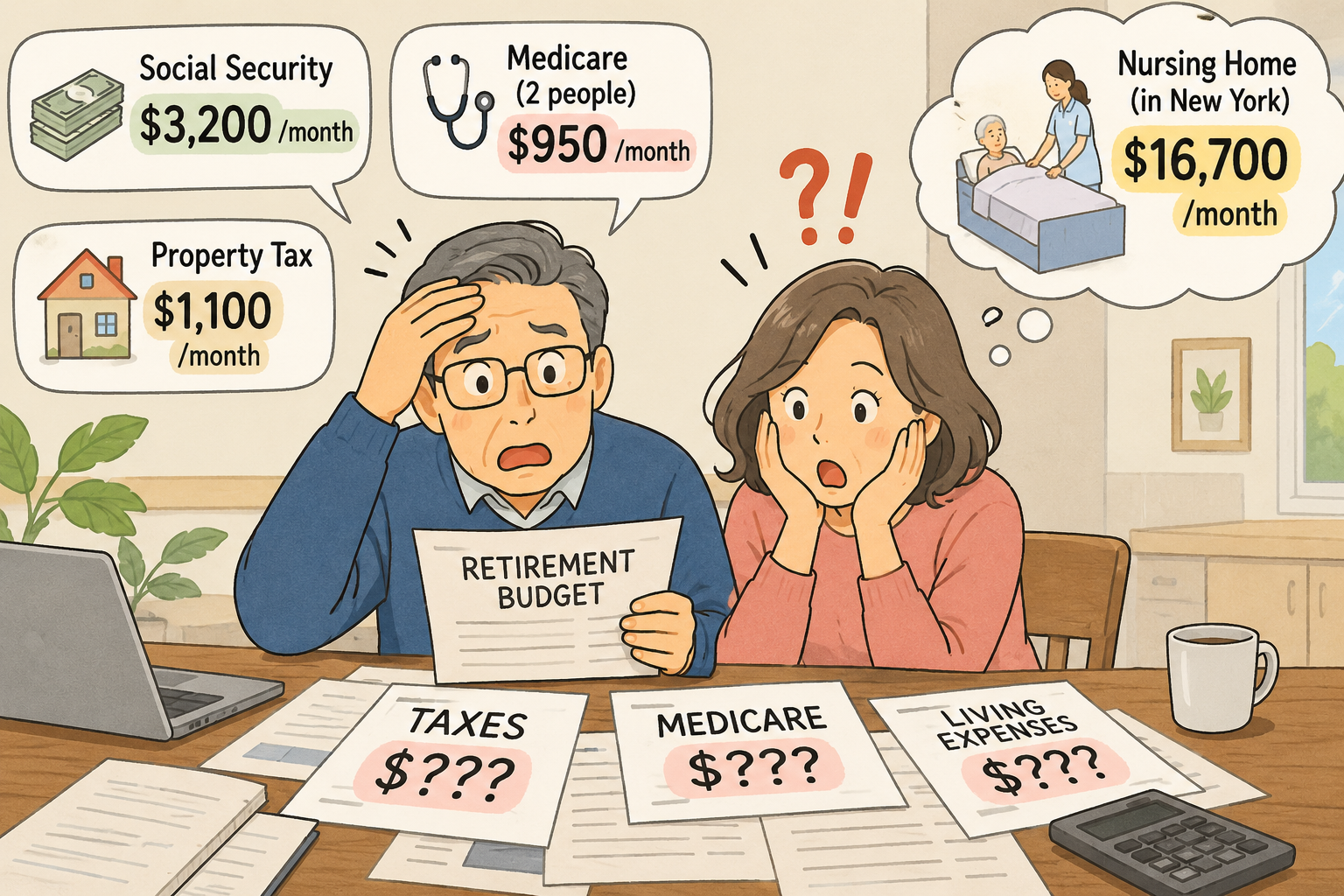
You may have saved enough to retire comfortably. But have you calculated what happens when healthcare costs rise or you eventually need long-term care?
When people plan for retirement, they usually think about traveling, spending time with family, and finally enjoying the money they’ve saved.
We often hear that we should save $1 million or more for retirement.
But how much does retirement actually cost?
For someone living in New York, the answer can be surprising.
Even after paying off your mortgage, you’ll still have property taxes, groceries, utilities, healthcare, and other everyday expenses.
And as you get older, medical care and the possibility of needing a nursing home can become major financial concerns.
Let’s look at realistic numbers to understand what retirement might actually look like.
1. How Much Money Does a Typical Retired Couple Receive?
Many retirees rely on Social Security, pensions, and withdrawals from retirement savings.
According to the Social Security Administration, the estimated average Social Security benefit for a retired couple where both receive benefits is approximately $3,208 per month in January 2026.
That’s about $38,500 per year.
This is a national estimate, not a New York-specific average. <Cite ref=”turn263541search11″/>
For a New York couple with additional savings, retirement income might look like this:
| Income source | Monthly amount |
|---|---|
| Social Security | $3,200 |
| Pension | $1,500 |
| 401(k) or IRA withdrawals | $2,000 |
| Total monthly income | $6,700 |
That’s approximately $80,400 per year before taxes.
This is an illustrative household, not the average New Yorker. There is no single typical retirement withdrawal amount because savings, pensions, and living expenses vary significantly.
But is $6,700 per month enough to live comfortably in New York?
2. What Does Retirement Actually Cost in New York?
Imagine a retired couple living on Long Island.
They own their home and have completely paid off their mortgage.
They aren’t living extravagantly, but they want to enjoy retirement without constantly worrying about money.
Here is an example of their monthly budget.
| Expense | Monthly estimate |
|---|---|
| Property taxes | $1,100 |
| Home insurance and maintenance | $650 |
| Utilities, internet, and phones | $450 |
| Groceries and household supplies | $850 |
| Transportation and car expenses | $550 |
| Medicare and other healthcare costs | $950 |
| Restaurants and entertainment | $400 |
| Travel savings | $500 |
| Clothing, gifts, and miscellaneous | $350 |
| Total | $5,800 |
That’s approximately $69,600 per year, even without a mortgage.
These are illustrative 2026 planning amounts for a Long Island homeowner, not surveyed averages. A renter, someone with a mortgage, or a retiree living in Manhattan may have a very different budget.
And this example doesn’t include income taxes.
Suddenly, a retirement income of $80,000 a year doesn’t seem quite as generous as it first appeared.
3. How Much Does Medicare Really Cost at Age 65?
Most Americans become eligible for Medicare at age 65.
But Medicare isn’t completely free.
In 2026, the standard Medicare Part B premium is $202.90 per person each month.
For a married couple, that’s approximately $406 monthly.
Part B generally covers doctor visits and outpatient medical services.
You may also need prescription drug coverage, supplemental insurance, or a Medicare Advantage plan, depending on the coverage you choose.
For budgeting purposes, imagine a retired couple with the following costs:
| Healthcare expense | Monthly couple estimate |
|---|---|
| Medicare Part B | $406 |
| Supplemental and drug coverage | $350 |
| Copays, dental, and other medical costs | $194 |
| Total | $950 |
That’s $11,400 per year.
The $950 is an example, not a universal Medicare cost. Actual premiums, coverage, and out-of-pocket expenses vary.
And there is another important surprise.
If your income is high enough, Medicare can charge you more for Part B and Part D.
This extra charge is called IRMAA.
For 2026, married couples filing jointly generally start paying higher premiums when their Medicare-calculated income exceeds $218,000.
The income calculation generally uses tax information from two years earlier.
This means large taxable 401(k) withdrawals, Roth conversions, or stock sales could increase future Medicare premiums. Qualified Roth IRA withdrawals generally don’t.
That’s one reason retirement planning isn’t only about how much money you’ve saved. It’s also about how you withdraw it.
4. What Happens When You Can No Longer Live Independently?
This is the retirement expense many families don’t prepare for.
Imagine a couple in their early 80s.
They have enjoyed retirement for almost 20 years.
Then one spouse develops health problems and needs help with bathing, dressing, walking, or daily activities.
The family may need to consider hiring a caregiver, moving to assisted living, or entering a nursing home.
And the costs in New York can be enormous.
New York Long-Term Care Costs
Based on the 2025 CareScout Cost of Care Survey, published in 2026:
| Type of care | Median monthly cost |
|---|---|
| In-home nonmedical caregiver, 44 hours/week | $6,673 |
| Assisted living | $7,110 |
| Nursing home, shared room | $15,528 |
| Nursing home, private room | $16,729 |
These are New York State median provider costs, not necessarily what a specific facility on Long Island will charge. <Cite refs={[“turn863668search3″,”turn863668search6”]}/>
<text color=”secondary”>Annual equivalent of New York long-term care costs</text>
| Type | Approximate annual cost |
|---|---|
| Home caregiver, 44 hours/week | $80,000 |
| Assisted living | $85,000 |
| Nursing home, private room | $201,000 |
A private nursing home room can cost more than $200,000 for just one year.
And unlike normal retirement expenses, this cost may arrive when someone is no longer able to manage their own care.
5. Doesn’t Medicare Pay for Nursing Homes?
This is one of the biggest misunderstandings about retirement healthcare.
Medicare generally does not cover long-term nursing home care when the primary need is help with daily living.
Medicare may cover short-term skilled nursing or rehabilitation under certain conditions.
But if someone needs ongoing help with bathing, dressing, eating, or other everyday activities, Medicare usually won’t pay for that long-term custodial care.
That means families may need to pay using savings, qualifying long-term care insurance, or Medicaid if they meet eligibility requirements. <Cite refs={[“turn263541search0″,”turn263541search8”]}/>
Medicaid is different from Medicare. It can cover qualifying long-term nursing facility care, but eligibility depends on financial and other rules.
6. Could a Nursing Home Use Up Your Retirement Savings?
Let’s imagine a couple who retired with $1 million invested.
They have been withdrawing money gradually to support their retirement.
At age 82, one spouse needs a private nursing home room.
Using the New York median cost of approximately $200,750 annually:
| Time in nursing home | Cost at today’s rates |
|---|---|
| 6 months | $100,375 |
| 1 year | $200,750 |
| 2 years | $401,500 |
| 3 years | $602,250 |
These are simplified costs assuming today’s prices stay constant. Actual costs may rise, and insurance or Medicaid may change the family’s out-of-pocket expenses.
For a married couple, the situation can be even more complicated.
One spouse may still be living at home and paying property taxes, utilities, groceries, and other expenses while the other spouse receives nursing home care.
This can place significant pressure on retirement savings.
7. How Can You Prepare Before Retirement?
You don’t need to predict exactly what your health will look like at age 85.
But you can prepare for different possibilities.
Start by estimating your real retirement expenses.
Don’t assume your spending will automatically drop when you stop working. Housing, healthcare, and everyday living costs continue.
Understand your Medicare coverage.
Compare premiums, deductibles, prescription coverage, and out-of-pocket costs rather than looking only at the monthly premium.
Build flexibility into your retirement savings.
A combination of traditional retirement accounts, Roth accounts, and taxable investments may provide more options for managing income and taxes.
Research long-term care before you need it.
Learn the differences between home care, assisted living, nursing homes, Medicaid, and long-term care insurance.
Review your estate plan.
Wills, powers of attorney, healthcare directives, and appropriate estate planning can help your family manage important decisions if you’re no longer able to do so yourself.
Final Thoughts: Retirement Isn’t Just About Reaching $1 Million
It’s easy to focus on reaching a retirement savings goal.
But having $1 million invested doesn’t automatically guarantee financial security for the rest of your life.
The real question is whether your savings, Social Security, pensions, and other income can support the lifestyle you want while also preparing for unexpected expenses.
For New Yorkers, the cost of living and long-term healthcare deserve special attention.
You may never need nursing home care. But understanding the potential cost gives you a chance to plan before your family faces a difficult decision.
A successful retirement plan isn’t just about how much money you have on the day you retire. It’s about how well that money can support you throughout the rest of your life.
Disclaimer: MoneyBloomDaily provides educational information, not individualized financial, tax, legal, insurance, or healthcare advice. Figures reflect published 2025–2026 benchmarks and illustrative household budgets. Actual costs, eligibility, and insurance coverage vary.
By Irene | Money Bloom Daily
Leave a Reply