
Two simple mortgage payment strategies that could save homeowners hundreds of thousands of dollars—without refinancing or making huge lump-sum payments.
Category: Family Money / Saving
What If You Could Finish Paying Your Mortgage 10 Years Earlier?
Buying a home is one of the biggest financial decisions most families will ever make.
Especially in places like Long Island and New York, where home prices, property taxes, and everyday living expenses can make homeownership feel overwhelming.
When we buy a house, we usually focus on the purchase price, interest rate, and monthly payment.
But there’s one question we don’t ask often enough:
How much money will we actually pay the bank over the next 30 years?
I recently started looking more closely at mortgage payments and discovered something surprising.
You don’t necessarily need to refinance into a 15-year mortgage or make enormous lump-sum payments to pay off your home much earlier.
Sometimes, small changes to your payment routine can make an incredible difference.
Let’s look at two strategies that could help you become mortgage-free more than 10 years earlier.
1. The Shocking Truth About a $500,000 Mortgage at 7%
Let’s imagine a family purchasing a home in New York.
They take out a $500,000 mortgage with a 7% fixed interest rate over 30 years.
Here is what their mortgage looks like.
| Mortgage Details | Amount |
|---|---|
| Original mortgage | $500,000 |
| Interest rate | 7% |
| Loan term | 30 years |
| Monthly principal and interest | $3,326.51 |
| Total payments over 30 years | $1,197,544 |
| Total interest paid | $697,544 |
Yes, you read that correctly.
You borrow $500,000 but end up paying nearly $1.2 million!
Almost $700,000 goes toward interest alone.
And that’s before property taxes, homeowners insurance, repairs, and maintenance.
Imagine what your family could do with even half of that interest money.
You could build your retirement savings, help your children with college, or simply have more financial freedom.
But here’s the good news.
You may not have to pay all that interest.
Why Are Mortgage Interest Payments So High?
During the early years of your mortgage, most of your monthly payment goes toward interest rather than reducing your debt.
For example, your first $3,326.51 mortgage payment would be divided approximately like this:
| First Mortgage Payment | Amount |
|---|---|
| Interest | $2,916.67 |
| Principal | $409.85 |
| Total payment | $3,326.51 |
Think about that.
You paid more than $3,300, but only about $410 actually reduced your mortgage balance.
That’s how mortgage amortization works.
Your interest is calculated based on your remaining loan balance.
As the principal decreases, the amount of interest charged also decreases.
This is why paying down your principal faster can save so much money.
2. Strategy #1: Make Biweekly Mortgage Payments
Most homeowners make 12 mortgage payments every year.
But what happens if you pay half of your monthly mortgage payment every two weeks instead?
Let’s use our $500,000 mortgage.
Traditional monthly payments:
$3,326.51 × 12 = $39,918 per year.
Biweekly payments:
$1,663.26 every two weeks.
Because there are 52 weeks in a year, you’ll make 26 half-payments.
That equals 13 full monthly payments instead of 12.
You’re effectively making one additional mortgage payment every year.
And because you’re dividing the payments across your paychecks, it may feel easier to manage.
How Much Could You Save?
| Payment Method | Payoff Time | Total Interest |
|---|---|---|
| Regular monthly payments | 30 years | $697,544 |
| Biweekly equivalent | 23 years, 9 months | $526,837 |
| Difference | 6 years, 3 months earlier | $170,707 saved |
By making the equivalent of one extra mortgage payment each year, you could save approximately $170,707 in interest.
And pay off your mortgage more than six years earlier.
That’s a remarkable difference.
Important: Not All Biweekly Programs Work the Same Way
Some banks accept biweekly payments directly.
Others hold partial payments until they receive the full monthly amount.
And some third-party companies charge fees for setting up biweekly payments.
Before enrolling, ask your mortgage servicer how the payments will be applied.
You can also achieve a similar result by keeping your normal monthly schedule and adding one-twelfth of your regular payment toward principal every month.
For this example, that means approximately $277 extra per month.
The calculations in this article use that monthly-equivalent method, so your actual results may vary slightly if your lender processes payments differently.
3. Strategy #2: Add Just 10% More Toward Your Principal
Now let’s try another approach.
Instead of changing your payment schedule, what if you simply added 10% to your regular mortgage payment?
Your normal monthly payment is $3,326.51.
An additional 10% is approximately $332.65.
That means your new monthly payment becomes:
$3,659.16
You are putting an additional $332.65 directly toward your mortgage principal every month.
Here’s what happens.
| Payment Method | Payoff Time | Total Interest |
|---|---|---|
| Regular monthly payments | 30 years | $697,544 |
| Monthly payment + 10% | 22 years, 11 months | $503,419 |
| Difference | 7 years, 1 month earlier | $194,126 saved |
That’s almost $200,000 in interest savings.
And you could finish paying your mortgage more than seven years earlier.
Why Does This Work?
Remember that your interest is calculated using your remaining principal balance.
When you make extra principal payments, you reduce that balance faster.
That means the bank calculates future interest on a smaller amount.
Over time, the savings compound.
But there’s one important detail.
Make sure your extra payment goes toward principal.
When making an additional payment, look for an option labeled:
Additional Principal or Principal Only.
If you don’t see that option, contact your mortgage servicer.
You want the additional money to reduce your outstanding balance, rather than simply being treated as an advance payment toward a future bill.
Afterward, check your mortgage statement to verify that the payment was applied correctly.
4. Strategy #3: Combine Both Methods and Save Over $280,000
Now comes my favorite part.
What if we combine both strategies?
First, we make the equivalent of 13 mortgage payments every year instead of 12.
Then we add another 10% of our original monthly mortgage payment toward principal.
Let’s see what happens.
The $500,000 Mortgage Comparison
| Strategy | Mortgage Payoff | Interest Paid | Interest Saved |
|---|---|---|---|
| Regular monthly payments | 30 years | $697,544 | — |
| Biweekly equivalent | 23 years, 9 months | $526,837 | $170,707 |
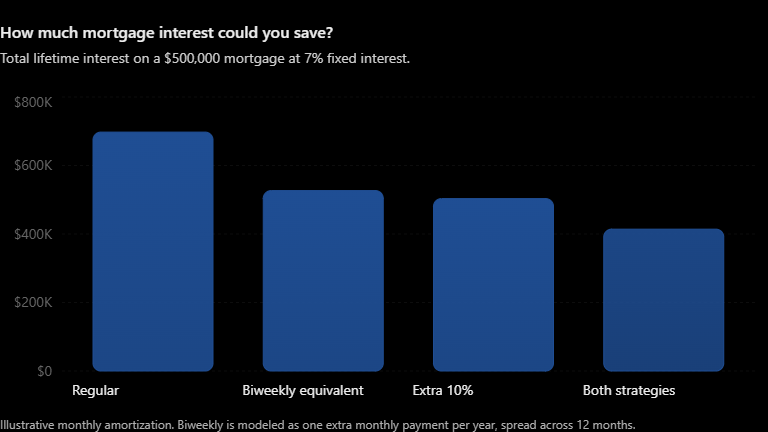
| Extra 10% monthly | 22 years, 11 months | $503,419 | $194,126 |
| Combine both | 19 years, 5 months | $414,150 | $283,395 |
You could become mortgage-free approximately 10 years and 7 months earlier.
And save more than $283,000 in interest.
Think about what that could mean for your family.
Instead of spending your late 50s or 60s worrying about mortgage payments, you might already own your home outright.
That could give you more flexibility to retire, change careers, or spend time with your children.
How Much Extra Money Would You Actually Need?
Let’s break down the numbers.
Your original monthly payment is $3,326.51.
To make the equivalent of one additional mortgage payment annually, you need approximately $277.21 more per month.
Then add another 10% of your regular payment, or $332.65.
Your total extra monthly payment becomes:
$277.21 + $332.65 = $609.86
Your new average monthly principal-and-interest payment becomes approximately:
$3,936.37
That means you’re contributing about $610 more every month.
For some families, that’s a meaningful amount of money.
But if you can afford it consistently, it could save you approximately $283,000 in future interest.
These estimates assume a $500,000 mortgage at a fixed 7% interest rate, with extra payments applied monthly to principal. They exclude taxes, insurance, fees, and other escrow costs.
5. Why Doesn’t Your Bank Encourage You to Pay Off Your Mortgage Faster?
Here’s something homeowners should understand.
Mortgage lenders and investors earn interest on outstanding mortgage balances.
When you reduce your principal faster, you generally reduce the total interest paid over the life of your loan.
That means an early payoff can reduce the expected interest income from that mortgage.
However, that doesn’t mean banks are secretly preventing homeowners from paying off their mortgages.
Many lenders openly explain the benefits of making extra principal payments.
Still, mortgage servicing systems aren’t always designed to make accelerated payments convenient.
You might discover that your lender doesn’t offer automatic biweekly payments.
Or that making extra principal payments requires a separate selection.
Sometimes, you need to contact customer service to confirm how the payment will be applied.
And some third-party companies charge fees for mortgage acceleration programs that homeowners may not need.
The important thing is to understand your options.
You don’t have to rely on your bank to create your financial strategy.
You can take control by learning how your mortgage works.
6. Watch Out for Prepayment Penalties and Extra Fees
Before making extra payments, check whether your mortgage has a prepayment penalty.
A prepayment penalty is a fee that certain lenders may charge when you pay off your mortgage early.
According to the Consumer Financial Protection Bureau, these penalties generally don’t apply to small additional principal payments, although specific loan terms matter.
Many conventional mortgages allow extra principal payments without penalties.
But you should always verify your own loan agreement.
Ask your mortgage servicer:
- Does my mortgage have a prepayment penalty?
- Can I make extra principal payments without fees?
- Does your bank offer biweekly payments?
- When are partial payments credited?
- Can I automatically add extra principal every month?
- How can I confirm that my extra payments reduced my balance?
If the bank doesn’t offer a convenient biweekly program, you can usually continue making your regular monthly payment and separately pay additional principal.
You may not need a special service at all.
7. What If You Can’t Afford an Extra $610 Every Month?
I understand that not every family has an additional $610 available each month.
Especially in New York.
Between property taxes, groceries, childcare, children’s activities, transportation, and retirement savings, it’s easy to feel like there’s nothing left.
But you don’t have to start with $610.
Maybe you start with $50.
Then increase it to $100 when your income improves.
If you receive a raise, consider directing part of it toward your mortgage.
When your car is paid off, you might redirect some of that payment toward principal.
If you receive a bonus, you could make a one-time extra principal payment.
The most important thing is consistency.
Even small extra payments can reduce your mortgage balance and save interest over time.
But don’t sacrifice your emergency savings or take on expensive credit card debt just to pay your mortgage faster.
Your financial security today matters just as much as your future goals.
8. Should Everyone Pay Off Their Mortgage Early?
Not necessarily.
This is where personal finance becomes personal.
If your mortgage rate is 7%, making additional principal payments can be financially attractive.
But what if you have a mortgage with a 2.5% or 3% interest rate?
You might prefer to invest the additional money for retirement.
Over a long period, a diversified investment portfolio could potentially earn more than the interest you’re saving.
Of course, investment returns aren’t guaranteed.
And mortgage interest savings can also depend on your tax situation.
There’s no single answer that’s right for everyone.
For some people, paying off a mortgage early provides peace of mind.
For others, investing the extra money offers greater flexibility and potentially higher long-term wealth.
The right choice depends on your interest rate, savings, financial goals, and tolerance for risk.
9. The Real Goal Is Financial Freedom
When I think about building wealth, I don’t necessarily imagine becoming rich overnight.
I think about having more choices.
The freedom to spend time with my family.
The ability to change jobs without worrying about the next mortgage payment.
The possibility of retiring earlier.
Or simply knowing that an unexpected expense won’t throw our entire financial plan off track.
For most middle-class families, a mortgage is one of their largest financial commitments.
And understanding how to manage that mortgage can make a tremendous difference.
You don’t need to become a financial expert.
You don’t need a complicated strategy.
Sometimes, building wealth starts with understanding where your money goes.
One extra payment each year.
A little more toward principal.
A consistent habit that helps you move closer to financial freedom.
Over time, those small decisions can create extraordinary results.
My Final Thought
Before making your next mortgage payment, take five minutes to review your statement.
Look at how much you’re paying in interest.
Look at how much is actually reducing your principal.
Then ask yourself:
Could I afford to put a little more toward my future?
You might be surprised by how much that small decision could change your financial life.
A Little More Breathing Room. A Wealthier Tomorrow.
By Irene | Money Bloom Daily
Sources and Further Reading
- Consumer Financial Protection Bureau — Mortgage Servicing Rules
- Consumer Financial Protection Bureau — What Is a Prepayment Penalty?
- Fannie Mae — Processing Additional Principal Payments
Disclaimer: This article is for educational purposes only and does not constitute personalized financial advice. Calculations are illustrative and assume a fixed interest rate, monthly amortization, and no additional fees. Actual mortgage payoff dates and savings depend on your loan agreement, payment timing, and mortgage servicer.
Leave a Reply