Why starting early matters, how compound growth works, and why it’s never too late to begin investing.
The First Time I Understood Compound Interest, I Was Shocked
I still remember the first time I truly understood how compound interest worked.
Of course, I knew investing money could help it grow over time. Most of us understand that basic idea.
But I never really understood how dramatically money could grow when the returns started earning returns of their own.
When I finally looked at the numbers over 10, 20, and 30 years, I couldn’t believe what I was seeing.
I remember thinking:
Why doesn’t everyone do this?
If money can grow this much simply by investing it and leaving it alone, isn’t this one of the easiest ways to become wealthy?
It almost seemed too good to be true.
But as I learned more about investing and experienced the financial responsibilities of raising a family, I realized something important.
Understanding compound interest is easy. Giving your money enough time to grow is the difficult part.
And while compound growth can be powerful, investing isn’t a guaranteed or effortless path to becoming wealthy.
What Is Compound Interest?
Compound interest means earning interest not only on your original savings but also on the interest you’ve already earned.
When investing in stocks or funds, we often call this compound growth, because returns may come from changes in investment value and reinvested dividends rather than a fixed interest rate.
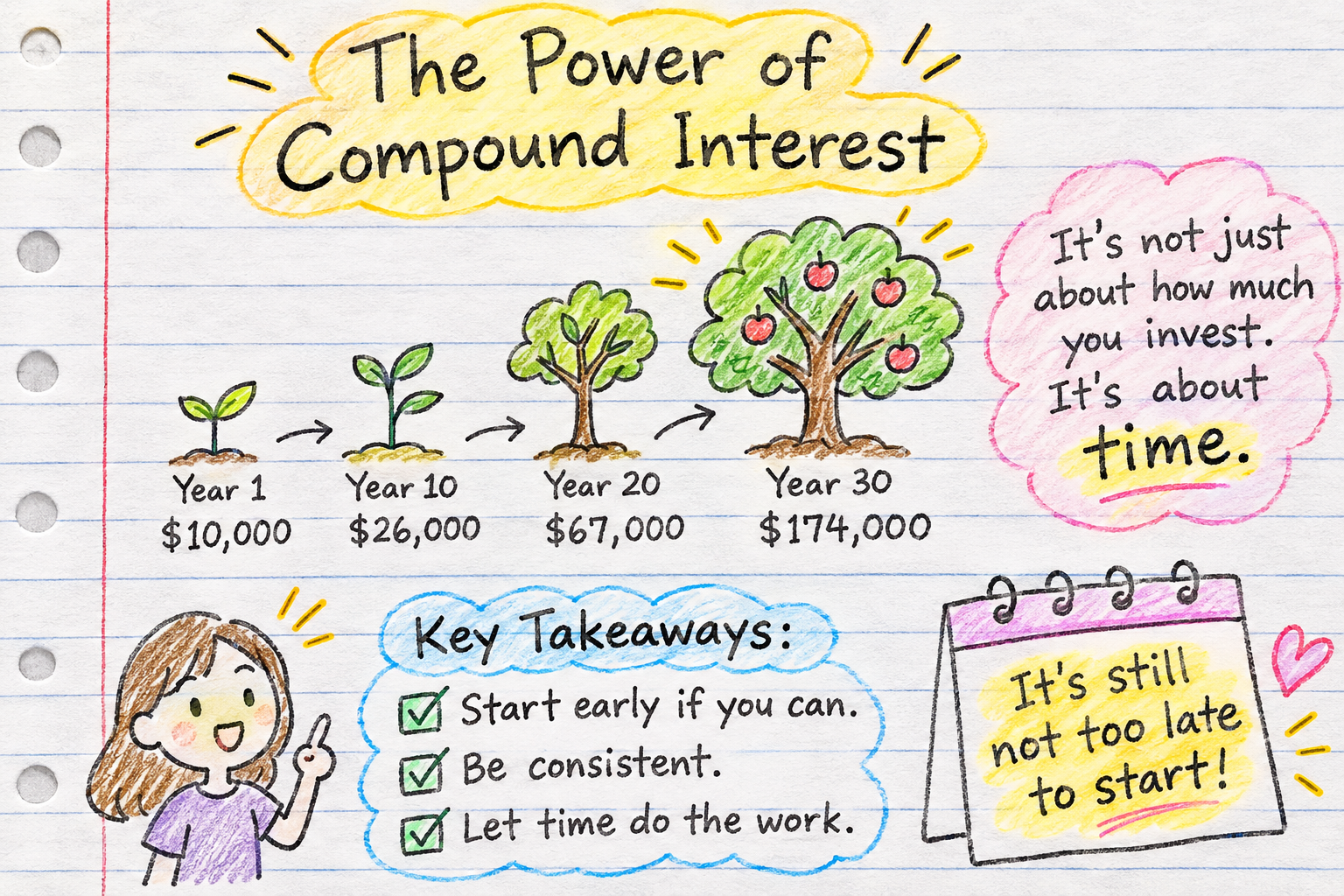
Imagine you invest $10,000 and earn a hypothetical 10% return every year.
- After 1 year: $11,000
- After 2 years: $12,100
- After 3 years: $13,310
- After 10 years: About $26,000
- After 20 years: About $67,000
- After 30 years: About $174,000
You started with just $10,000.
Without investing another dollar, your money could mathematically grow to approximately $174,000 over 30 years.
That’s the power of compounding.
Of course, actual investments don’t earn exactly 10% every year. Some years may bring strong gains, while others may bring losses.
The U.S. Securities and Exchange Commission offers a free compound interest calculator that lets you experiment with different contributions, rates, and investment periods.
How Much Can $10,000 Grow at Different Investment Returns?
Even a small difference in annual returns can create an enormous difference over several decades.
| Years invested | 5% return | 7% return | 10% return |
|---|---|---|---|
| 10 years | $16,000 | $20,000 | $26,000 |
| 20 years | $27,000 | $39,000 | $67,000 |
| 30 years | $43,000 | $76,000 | $174,000 |
| 40 years | $70,000 | $150,000 | $453,000 |
Assumes a one-time $10,000 investment, annual compounding, and no additional contributions. Values are rounded.
Notice what happens after 40 years.
At 5%, your original $10,000 grows to about $70,000.
At 10%, it grows to more than $450,000.
That’s why both investment returns and time matter so much.
But there is another lesson I find even more powerful.
The age at which you start investing can make an enormous difference.
What If You Started Investing Just $100 a Month at Age 1?
Imagine parents begin investing $100 every month for their child starting at age 1.
They continue contributing for 30 years, until the child turns 31.
During those 30 years, they invest a total of $36,000.
Then they stop contributing completely.
The money remains invested and continues growing until the child reaches age 70.
Assuming a hypothetical 10% nominal annual return compounded monthly, here’s how the investment could grow.
| Age | Total contributed | Investment value |
|---|---|---|
| 11 | $12,000 | $20,000 |
| 21 | $24,000 | $76,000 |
| 31 | $36,000 | $226,000 |
| 41 | $36,000 | $612,000 |
| 51 | $36,000 | $1.66 million |
| 61 | $36,000 | $4.48 million |
| 70 | $36,000 | $10.99 million |
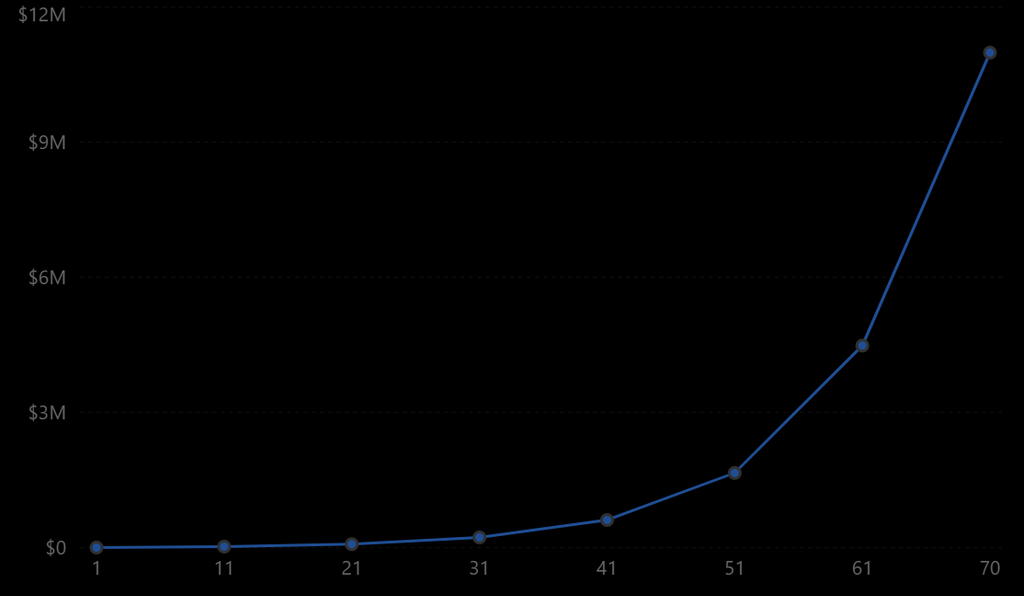
Assumes contributions at the end of each month for 30 years, then no additional contributions. All figures are hypothetical and rounded. Taxes, fees, and inflation are excluded.
The most incredible part?
The family contributed only $36,000.
After contributions stop, the money could continue growing for decades without another dollar being added.
Under these mathematical assumptions, the portfolio could reach almost $11 million by age 70.
But this is not a prediction. A constant 10% return over such a long period is an illustration, not something any investor can count on. The purchasing power of $11 million decades from now would also be substantially lower than it is today.
What I find most fascinating isn’t the final dollar amount.
It’s the shape of the growth curve.
In the beginning, the investment grows slowly.
But over time, the potential growth becomes dramatically larger.
It’s not just about how much money you invest. It’s about how much time you give your money to grow.
What If You’re Already 30, 40, or 50? Is It Too Late?
Absolutely not.
When we see examples of someone investing from childhood, it’s easy to think we’ve already missed our opportunity.
But that’s not the message I want you to take away.
You may not have 60 or 70 years ahead of you, but you can still make meaningful financial progress.
For example, imagine you’re 40 years old and begin investing today.
| Monthly investment | Years invested | Potential value at age 65 |
|---|---|---|
| $100 | 25 | $81,000 |
| $300 | 25 | $243,000 |
| $500 | 25 | $405,000 |
Assumes a hypothetical 7% nominal annual return compounded monthly, with no starting investment. Values are rounded.
Even starting at 40, investing $300 a month could mathematically grow into approximately $243,000 by age 65.
And if you’re starting at 50, you can still benefit from investing, although your shorter time horizon may call for a different balance of risk and stability.
The important thing is not to compare your starting point with someone else’s.
You can’t change when you started, but you can change what you do next.
The SEC’s Introduction to Investing also explains important investing principles, including risk and long-term planning.
But Here’s What Nobody Tells You About Investing Every Month
When I first learned about compound interest, I thought building wealth was surprisingly simple.
Just invest a certain amount every month, let the money grow, and wait.
But real life doesn’t always work that way.
As a working parent, I’ve realized how difficult it can be to invest consistently, especially when you have a family.
Some months, everything goes according to plan.
Other months, expenses seem endless.
Your child needs something unexpected. The car needs repairs. Someone in the family gets sick. Medical bills arrive. Property taxes increase.
Or you simply have a month when your paycheck is already stretched too thin.
Suddenly, the money you planned to invest needs to go somewhere else.
And sometimes, it isn’t just one month. It can be several months in a row.
That’s when I realized something important.
The hardest part of investing isn’t understanding compound interest. It’s maintaining the habit through all the unpredictable moments of life.
What Happens If You Can’t Invest Every Month?
Here’s some encouraging news.
Missing a few months doesn’t mean your entire investment plan has failed.
Imagine you planned to invest $300 every month for 30 years, earning a hypothetical 7% nominal annual return compounded monthly.
| Investment habit | Value after 30 years |
|---|---|
| $300 every month | $366,000 |
| $300 for 10 months each year | $307,000 |
| $200 every month | $244,000 |
Assumes contributions at the end of each month, no starting balance, and a constant 7% nominal annual return compounded monthly. The 10-month example skips November and December each year. Figures are rounded.
Even if you miss two months every year, you could still build an investment account worth approximately $307,000 under these assumptions.
Of course, investing more consistently generally produces a larger balance.
But you don’t have to be perfect to make meaningful financial progress.
Five Ways to Make Compound Growth Work in Real Life
1. Start with an amount you can comfortably afford.
Instead of forcing yourself to invest $500 every month and struggling to maintain it, consider starting with $100 or $200.
A smaller amount you can sustain is often more useful than an ambitious plan you abandon.
2. Automate your investments.
If possible, arrange for money to transfer automatically into your investment account every payday.
Even small automatic contributions can help build a habit.
3. Build an emergency fund.
Unexpected expenses are part of life, especially when you have children.
Having money available for emergencies can help you avoid selling investments when the market is down.
4. Increase your contributions as your income grows.
You don’t need to start big.
If you begin with $100 a month, consider increasing your contributions when you receive a raise or your expenses decrease.
5. Think in decades, not months.
Investing isn’t about getting rich next year.
It’s about gradually building financial security over many years.
Consider diversified investments that fit your goals, time horizon, and ability to handle losses. Diversification can help manage risk, although it cannot eliminate the possibility of losing money.
You can learn more from the SEC’s guide to asset allocation and diversification.
How We’re Teaching Our Children to Invest Early
After understanding the power of compound growth, I started thinking about how we could give our children a financial head start.
In our family, we’re helping our children build investments through brokerage accounts.
And the money doesn’t all come from us.
Some comes from grandparents, birthday gifts, and other money they receive throughout the year.
For example, their grandparents contribute $50 a month, and we add another $50.
We also started thinking differently about birthday celebrations.
Instead of throwing a big birthday party every year, we sometimes choose a small celebration with one or two close friends and put $500 into their investments.
Of course, we still want our children to enjoy their birthdays, have fun with friends, and make wonderful childhood memories.
We’re not trying to replace every experience with money.
We’re simply trying to find a balance between enjoying today and preparing for tomorrow.
And honestly, $100 a month may not seem like much.
But after learning how compound growth works, I see that money differently.
I no longer think of it as just $100.
I think about what that money could become in 20, 30, or even 50 years.
More importantly, I want our children to understand why we’re doing this.
I want them to learn that money doesn’t always need to be spent immediately. Sometimes, allowing it to grow can create opportunities later in life.
I hope that one day, when they’re adults, they’ll look at their investment accounts and understand that the most valuable thing we gave them wasn’t just money.
It was time, financial knowledge, and the habit of thinking about their future.
And that’s something I believe every family can begin teaching, regardless of how much money they have.
Final Thought: Start Where You Are
The first time I understood compound interest, I thought building wealth would be easy.
But after years of managing family expenses, unexpected emergencies, and everyday responsibilities, I realized that investing consistently isn’t always simple.
Some months, you can invest more.
Some months, you may need to invest less.
And sometimes, you may need to pause altogether.
That’s part of real life.
Don’t let an imperfect month make you give up on your long-term goals.
Start with what you can comfortably afford, build an emergency fund, and gradually increase your investments when possible.
And if you have children, consider giving them the advantage of time while they’re still young.
It’s never too late to begin building your own financial future, and it’s never too early to teach your children how money can grow.
Important Disclaimer
This article is for educational purposes only and does not constitute personalized financial, investment, or tax advice.
All investment examples are hypothetical and assume fixed returns. Actual market performance varies, investments can lose value, and taxes, fees, and inflation can significantly reduce the final value.
Before contributing money to an investment account, especially one intended for your children, make sure you understand the applicable tax rules, potential tax benefits, withdrawal restrictions, and possible effects on college financial aid and scholarship eligibility.
Tax treatment depends on the account type, ownership, and individual circumstances. Consider consulting a qualified tax or financial professional before making investment decisions.
By Irene | Money Bloom Daily
Leave a Reply