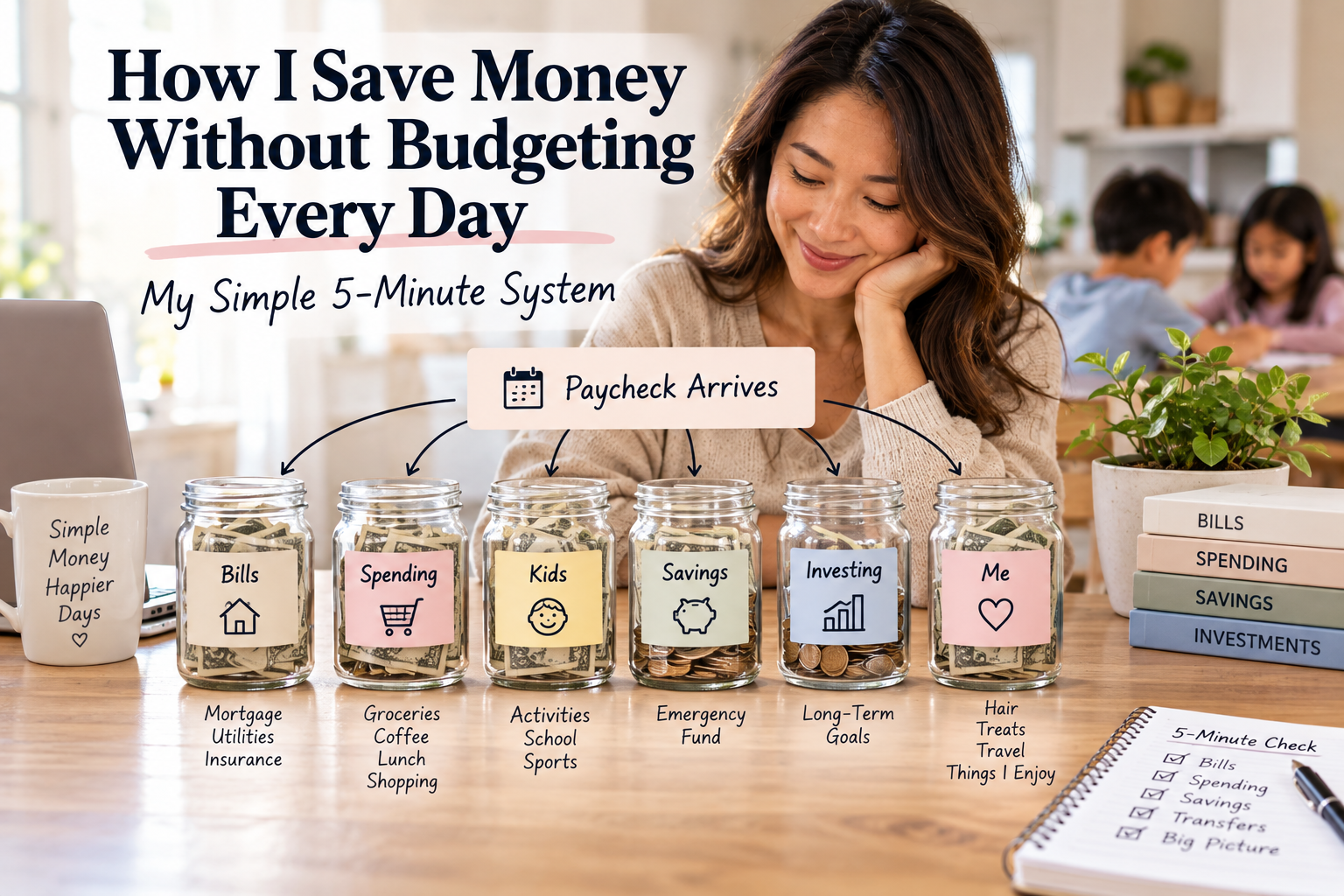
Pay off debt, save automatically, and manage everyday spending without complicated spreadsheets.
Have you ever watched a YouTube video about saving money and felt inspired?
You decide to create a budget. You download an app, organize your expenses, and promise to track every purchase.
For a few days, everything goes well.
Then life gets busy.
Between work, kids, grocery shopping, and household chores, who has time to record every coffee or grocery purchase?
I certainly don’t!
As a working mom with two kids, I already have enough things to manage. I don’t want another job managing my money.
Over the years, I’ve tried different budgeting methods. However, most required too much time and attention.
Eventually, I realized something.
I didn’t need a more complicated budget. I needed a simpler system.
My approach has four steps:
- Pay off expensive credit card debt.
- Save automatically when I get paid.
- Manage everyday expenses with the money left over.
- Check my finances in about five minutes.
Here’s how it works.
Step 1: Pay Off High-Interest Credit Card Debt
Before focusing on growing my savings, I needed to address my credit card debt.
In the past, I often waited for a bonus or tax refund to pay off my balance.
I thought that once I received extra money, I could start fresh.
However, that plan didn’t work well for me.
I was depending on money I hadn’t received yet. Meanwhile, interest kept adding up.
Why paying off debt matters
Let’s say you have $5,000 in savings.
At the same time, you owe $5,000 on a credit card.
Here’s a simple comparison.
| Savings | Credit card debt | |
|---|---|---|
| Balance | $5,000 | $5,000 |
| Interest rate | 4% | 24% |
| Approximate annual interest | +$200 | −$1,200 |
In this simplified example, your credit card costs $1,000 more in interest than your savings earns.
That’s money that could have gone toward your financial goals.
Of course, you shouldn’t empty your bank account to pay off debt. You still need enough cash for essential bills and unexpected expenses.
However, paying down high-interest debt is often an important first step.
What I changed
Instead of waiting for future bonuses, I focused on paying down my balance.
I also made it a goal to stop carrying credit card debt from month to month.
Now, I aim to pay my full statement balance by the due date.
If you already have debt, start with a realistic repayment plan. You can also build a small emergency cash cushion while paying it down.
My first rule: Stop paying unnecessary credit card interest before focusing on extra long-term savings.
Once expensive debt is under control, it’s easier to focus on the next step.
Step 2: Save Automatically When You Get Paid
After getting expensive debt under control, my next goal was to save consistently.
I used to save whatever money was left at the end of the month.
Unfortunately, there often wasn’t much left!
There were always groceries, bills, kids’ activities, and unexpected purchases.
So, I changed the order.
Instead of spending first and saving later, I started setting aside savings when my paycheck arrived.
This is often called paying yourself first.
How automatic saving works
Let’s imagine your monthly take-home income is $5,000.
After reviewing your essential bills, you decide that you can afford to save $500 each month.
Instead of waiting until the end of the month, you schedule an automatic transfer.
| Monthly paycheck | $5,000 |
|---|---|
| Automatic savings | −$500 |
| Money available for expenses | $4,500 |
The $500 moves into your savings account automatically.
As a result, you don’t have to remember to save each month.
Of course, you should choose an amount that leaves enough money for your bills.
Where should your savings go?
I like separating my savings into two goals.
Emergency savings
This money is for unexpected expenses, such as car repairs or a loss of income.
A common goal is three to six months of essential living expenses.
You can build this amount gradually.
Long-term investments
Once my emergency savings are on track, I also like investing for the future.
For example, a brokerage account can be useful for long-term goals.
Many brokerages offer automatic investing.
However, investments can lose value. Therefore, money needed soon should generally stay in accessible, lower-risk savings.
The important part is consistency.
My second rule: Save first, then organize the money that’s left.
Step 3: Manage Your Expenses With the Money Left Over
Now comes the part that makes my life easier.
After setting aside savings, I organize the remaining money for everyday expenses.
This helps me avoid spending money that already has another purpose.
Give your remaining money a job
Let’s continue with the $5,000 monthly paycheck example.
You already transferred $500 into savings.
That leaves $4,500 for your monthly expenses.
Here’s one way to organize it.
| Account | Monthly amount |
|---|---|
| Bills and mortgage | $2,500 |
| Groceries and household | $900 |
| Kids and family activities | $500 |
| Personal spending | $300 |
| Other expenses and buffer | $300 |
| Total remaining | $4,500 |
These amounts are only examples.
Every family has different expenses. Therefore, you should adjust the amounts to fit your needs.
The goal is to separate money based on how you plan to use it.
Use different accounts to stay organized
I like the idea of using separate accounts for different expenses.
For example:
Account 1: Bills
This account covers the mortgage, utilities, insurance, and other regular payments.
I don’t want to accidentally spend money needed for these bills.
Account 2: Groceries and household expenses
This account covers food, household supplies, and everyday family needs.
Account 3: Kids and family activities
With two kids, expenses can add up quickly.
There are school activities, sports, lessons, birthday parties, and other events.
A separate account makes these expenses easier to manage.
Account 4: Personal spending
This is money I can enjoy without worrying about my bills.
Maybe I want a new outfit, a haircut, or lunch with a friend.
Because I’ve already set aside money for bills and savings, I can spend this amount more comfortably.
You don’t need four checking accounts to make this work.
Some banks let you create separate spending or savings buckets. You can also start with just two accounts.
My favorite trick: A weekly spending allowance
For smaller purchases, I use a weekly allowance.
I transfer a fixed amount into Apple Cash.
Then, I use it for coffee, lunch, and personal purchases.
For example, imagine I give myself $75 each week.
| Purchase | Balance left |
|---|---|
| Weekly allowance | $75 |
| Coffee | $68 |
| Lunch | $53 |
| Small purchase | $28 |
When the balance gets low, I know it’s time to slow down.
And when I run out, I wait until the next week for nonessential purchases.
I don’t need to record every purchase in a spreadsheet.
Instead, I simply check the balance.
My third rule: Give every dollar a purpose, and spend within the amount available.
Automate your expense accounts, too
Here’s another important part.
You don’t need to move money manually between accounts every payday.
Once you know your spending limits, you can schedule recurring bank transfers.
For example, money can automatically move into your grocery, family, and personal spending accounts.
Before setting this up, check for bank fees, transfer limits, and minimum balance requirements.
Also, make sure transfers happen before bills are due.
Once the system is running, your money stays organized with less daily effort.
Step 4: Check Your Finances in Five Minutes
Now that your money has a plan, you don’t need to spend hours checking your accounts every day.
Instead, I like doing a quick check once a week or around payday.
My five-minute money checklist
Minute 1: Check upcoming bills
Is there enough money to cover the mortgage, utilities, and other payments?
Minute 2: Check everyday spending
How much money is left for groceries, household needs, and personal purchases?
Minute 3: Check savings
Did the automatic transfer go through? Is my emergency fund growing?
Minute 4: Check other transfers
Did money move into the correct spending accounts?
Minute 5: Look at the big picture
Is there anything unusual? Do I need to adjust my spending before the next paycheck?
That’s it!
Of course, I still review my bank statements and transactions regularly.
This helps me catch errors, unexpected charges, and fees.
However, I don’t need to track every purchase every day.
Why This Simple Saving System Works for Me
For a long time, I thought saving money required more discipline.
I believed I needed to track every expense and constantly remind myself to spend less.
However, I eventually realized something important.
Saving money becomes easier when you make fewer financial decisions.
When I focus on paying off expensive debt, I avoid unnecessary interest.
When my savings happen automatically, I don’t have to remember to save.
When my expenses are separated, I know how much money is available.
And when I check my accounts for five minutes, I can stay informed without spending hours managing my finances.
Most importantly, I still have room to enjoy life.
I don’t believe saving money should mean giving up every coffee, dinner, or personal treat.
Instead, I believe those expenses should have their own place in the budget.
Frequently Asked Questions
Should I pay off debt before saving money?
Paying down high-interest credit card debt is often a priority. However, you should still keep enough accessible cash for essential expenses and emergencies.
How can I save money automatically?
Most banks allow you to schedule recurring transfers between accounts. You can set up transfers around your payday.
How much should I automatically save?
Start with an amount you can comfortably afford after essential expenses. You can increase it as your finances improve.
Do I need several bank accounts?
No. You can start with two or three accounts. Some banks also offer separate savings buckets.
Can I manage money without tracking every purchase?
Yes. Separate spending accounts and automatic transfers can reduce the need for daily tracking. However, reviewing your statements regularly is still important.
Final Thoughts: Make Your Money Work for You
I’m a working mom with two kids.
Between my job, family, and everyday responsibilities, I don’t want money management to become another full-time job.
That’s why I prefer a simple system.
First, I focus on getting expensive debt under control.
Next, I save automatically when I get paid.
Then, I organize the remaining money into separate accounts for bills and everyday expenses.
Finally, I check my finances for about five minutes.
Of course, I still need to make adjustments when life changes.
However, I no longer feel that I need to manage every dollar by hand.
If you’ve tried complicated budgeting systems and couldn’t stick with them, start small.
Focus on one step at a time.
Pay off expensive debt. Save automatically. Spend what’s left wisely.
You don’t need a perfect budget.
You need a simple system that works for your life.
By Irene | Money Bloom Daily
Disclaimer: This article reflects personal experience and provides general financial education. It is not individualized financial or investment advice. Your best approach depends on your income, debt, expenses, and financial goals.
Leave a Reply