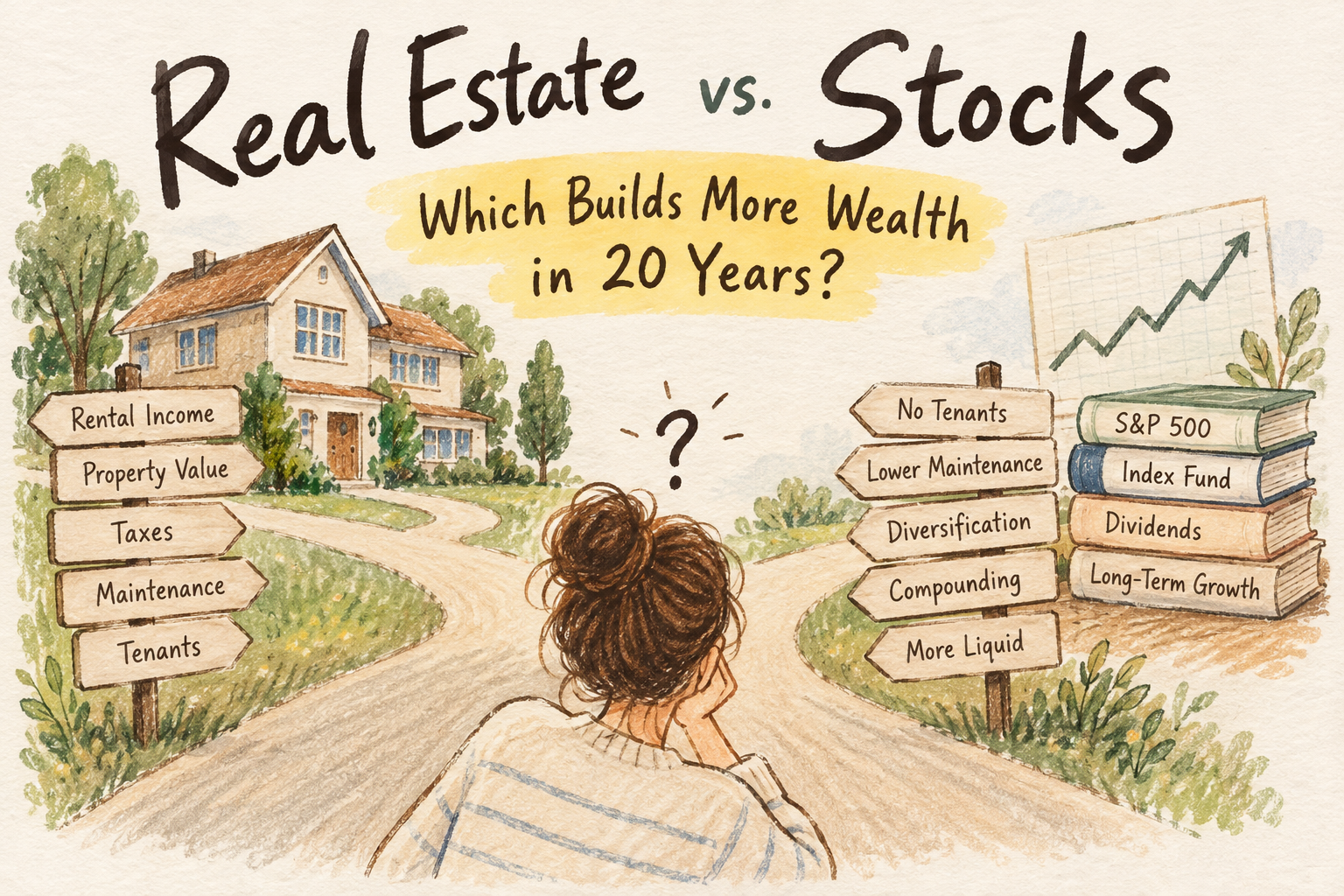
Real Estate vs Stocks: Why We Chose Stocks After Buying a Home
Which investment could build more wealth over 20 years? A personal look at rental property, stock investing, mortgage costs, income taxes, retirement, and inheritance.
Real Estate vs Stocks: The Investment Question I Couldn’t Answer
Real estate vs stocks was one of the biggest questions I had when I first became interested in investing.
I’ve always believed that investing is important. But for a long time, I didn’t know where to put our money.
When I read Robert Kiyosaki’s books about real estate investing, I found the idea fascinating.
Imagine owning a property that increases in value while tenants help pay the mortgage. Eventually, you might own a valuable asset that generates rental income every month.
It sounded like an excellent way to build wealth.
Then I started reading about Warren Buffett and his long-term approach to investing in businesses.
Suddenly, the stock market seemed just as appealing.
Instead of managing a rental property, I could invest in a diversified portfolio and give my money time to grow.
Both approaches made sense.
But I couldn’t decide which was better.
Then we moved into our single-family home, and my perspective began to change.
Why Owning a Home Changed My View of Real Estate Investing
Before becoming a homeowner, I mostly thought about real estate as an appreciating asset.
I knew houses needed maintenance, but I didn’t realize how frequently something would require attention.
After moving into our single-family home, it seemed like there was always something to fix.
Sometimes it was a roof issue. Other times, a leaking window, the water heater, or the HVAC system.
Whenever the seasons changed, another maintenance project seemed to appear.
Some repairs were manageable. Others were expensive and unexpected.
That experience made me think about what owning a rental property would actually involve.
If maintaining our own house already required so much time and money, what would happen if we owned another property with tenants?
We would have to deal with repairs, vacancies, insurance, property taxes, and possibly difficult tenant situations.
Of course, many real estate investors hire property management companies.
That could make ownership easier, but management services also cost money. We haven’t explored that option in detail yet.
Eventually, we decided to focus on the stock market instead.
Stock investing still requires research and discipline. However, it doesn’t involve replacing a roof or responding to a tenant’s broken heating system.
For our family, that difference mattered.
We weren’t simply choosing the investment with the highest possible return. We were choosing the investment that fit our lifestyle.
Still, I wanted to understand the numbers.
Could rental real estate actually produce more wealth than stocks over 20 years, even after mortgage interest, repairs, taxes, and other expenses?
Let’s compare.
1. Real Estate vs Stocks: Investing $100,000 Over 20 Years
Imagine two investors who each have $100,000.
One uses the money as a down payment on a rental property.
The other invests it in a diversified stock index fund.
We’ll compare the results using hypothetical assumptions, not predictions.
Investment A: Buying a rental property
| Rental property assumptions | Amount |
|---|---|
| Property purchase price | $500,000 |
| Down payment | $100,000 |
| Mortgage amount | $400,000 |
| Mortgage rate | 7% fixed |
| Loan term | 30 years |
| Monthly mortgage principal and interest | $2,661 |
| Starting monthly rent | $3,500 |
| Annual rent growth | 2% |
| Annual property appreciation | 3% |
| Operating expenses | 30% of rent |
| Additional purchase closing costs | $15,000 |
The 30% operating-expense assumption covers a combined allowance for property taxes, insurance, maintenance, vacancy, and management.
It does not include mortgage payments.
Actual expenses vary significantly by property and location. Major repairs or unusually high taxes could make the investment less profitable.
Investment B: Buying stocks
| Stock investment assumptions | Amount |
|---|---|
| Initial investment | $100,000 |
| Investment type | Diversified stock index fund |
| Hypothetical annual compound return | 7% |
| Investment period | 20 years |
| Additional contributions | $0 |
| Dividends | Reinvested |
The assumed 7% return is a simplified planning figure before personal taxes, not a guaranteed return.
Unlike rental property, the stock investor does not borrow money or make ongoing mortgage payments.
2. How Much Does a Rental Property Actually Earn After Expenses?
This is where real estate investing becomes more complicated.
When someone says a rental property generates $3,500 per month, it’s easy to assume they’re making $3,500.
But rental income is not the same as profit.
Let’s examine the first year.
First-year rental property cash flow
| Monthly income and expenses | Amount |
|---|---|
| Rental income | $3,500 |
| Property taxes, insurance, maintenance, vacancy and management allowance | −$1,050 |
| Mortgage principal and interest | −$2,661 |
| Monthly cash flow | −$211 |
| Annual cash flow | Approximately −$2,535 |
In this example, the investor must contribute approximately $2,535 from other savings during the first year.
And that’s after collecting $42,000 in annual rent.
However, the investor is also gradually paying down the mortgage.
A portion of each payment reduces the loan balance and builds equity.
This is an important difference between cash flow and long-term wealth.
A rental property can lose money each month while still building equity—but that doesn’t guarantee it will be a good investment.
What happens over 20 years?
Assuming rents rise by 2% annually and operating expenses remain 30% of rent, cash flow improves over time because the mortgage principal-and-interest payment stays fixed.
Meanwhile, the property may appreciate.
Here are the hypothetical results after 20 years.
| Rental property after 20 years | Estimated amount |
|---|---|
| Property market value | $903,056 |
| Remaining mortgage balance | −$229,200 |
| Property equity | $673,855 |
| Selling costs at 6% | −$54,183 |
| Net proceeds from selling | $619,672 |
| Cumulative rental cash flow over 20 years | +$75,652 |
| Combined sale proceeds and rental cash flow | $695,324 |
These figures are before personal income taxes, including any taxes triggered by selling the property.
The $75,652 of cumulative cash flow represents money received or contributed over 20 years, not an additional lump sum earned at the end. It has not been reinvested in this calculation.
The investor also spent $115,000 initially, including the down payment and assumed closing costs.
The result looks impressive, but remember that it depends on using substantial mortgage debt.
If home prices decline, rental income disappoints, or operating expenses rise, the outcome could be significantly worse.
3. How Much Could $100,000 in Stocks Grow?
Now imagine investing the same $100,000 in a diversified stock index fund.
If the investment compounds at a hypothetical 7% annually, the growth looks like this:
| Year | Portfolio value |
|---|---|
| Starting investment | $100,000 |
| Year 5 | $140,255 |
| Year 10 | $196,715 |
| Year 15 | $275,903 |
| Year 20 | $386,968 |
After 20 years, the stock portfolio could be worth approximately $387,000.
That’s about $287,000 in investment growth before taxes.
Unlike real estate, the investor doesn’t have tenants, property taxes, building maintenance, or mortgage payments.
However, stocks have their own risks.
Markets can decline sharply, sometimes for extended periods. There is no guarantee of a 7% return, and a diversified portfolio can still lose value.
The advantage is simplicity.
With a diversified index fund, investors can participate in the growth of many businesses without personally managing those companies.
4. Real Estate vs Stocks: The 20-Year Comparison
Here’s the comparison that helped me understand the difference.
| After 20 years | Rental property | Stock index fund |
|---|---|---|
| Starting investment | $100,000 down payment | $100,000 |
| Additional upfront costs | $15,000 | Not modeled |
| Ending property or portfolio value | $903,056 | $386,968 |
| Remaining mortgage | $229,200 | $0 |
| Estimated selling costs | $54,183 | Not modeled |
| Ending value after debt and selling costs | $619,672 | $386,968 |
| Rental cash flow over 20 years | +$75,652 | Dividends reinvested |
| Property management or maintenance | Required | Not required |
| Ease of selling | Lower | Generally higher |
At first glance, real estate appears to produce more wealth.
But that doesn’t mean real estate is automatically the better investment.
The rental investor used a $400,000 mortgage to purchase a larger asset. The stock investor didn’t borrow money.
The rental investor also paid additional closing costs and experienced both negative and positive cash flows throughout the investment.
To compare returns fairly, we would need to account for when every dollar was invested or received, whether rental cash flow was reinvested, and the taxes each investor paid.
Real estate may offer stronger returns through leverage, while stocks offer simpler ownership, easier diversification, and greater flexibility.
Neither advantage should be overlooked.
5. Real Estate vs Stocks: How Do They Affect Your Income Taxes Every Year?
One of the biggest differences between rental property and stocks is how they affect your annual tax return.
And this is something I believe every investor should understand before deciding where to invest.
Rental income is reportable even when you have a mortgage
Suppose you own a rental property and collect $3,500 per month.
That’s $42,000 in annual gross rental income.
Even though you’re still paying a mortgage, the rent is generally reportable on your federal tax return.
But you don’t automatically pay income tax on the entire $42,000.
You can generally deduct eligible rental expenses.
These may include:
- Mortgage interest, but not mortgage principal payments
- Property taxes and insurance
- Eligible repairs and maintenance
- Property management fees
- Certain other operating expenses
- Depreciation of the rental building
For most individual landlords, rental activity is reported on Schedule E.
Example: Rental property taxable income
Here’s a simplified illustration using our first-year rental property.
| Rental tax calculation | Approximate amount |
|---|---|
| Gross annual rent | $42,000 |
| Operating expenses | −$12,600 |
| Mortgage interest | −$27,800 |
| Building depreciation | −$14,545 |
| Estimated taxable rental result | −$12,945 |
The depreciation example assumes $400,000 of the property cost is allocated to the residential rental building and $100,000 to land. Residential rental buildings are generally depreciated over 27.5 years.
The mortgage interest amount is rounded.
Notice something surprising.
The property collects $42,000 in rent, but it may report a tax loss after eligible expenses and depreciation.
However, that doesn’t mean the owner can automatically deduct the loss against salary income.
Rental losses are generally subject to passive-activity limitations. Depending on income, participation, and other factors, losses may be currently deductible or carried forward.
Also, depreciation deductions can create additional tax consequences when the property is sold.
Your rental property’s cash flow and taxable income are two different numbers.
How stock investments affect your annual taxes
Now imagine your $100,000 stock portfolio grows to $110,000 during the first year.
You haven’t sold any shares.
In a regular taxable brokerage account, that $10,000 of unrealized appreciation generally doesn’t create a capital gains tax bill.
You typically owe capital gains tax when you sell investments for a profit.
However, dividends and certain fund distributions may be taxable each year, even if reinvested.
For example:
| Stock investment event | General tax treatment |
|---|---|
| Portfolio increases by $10,000 without selling | Generally no capital gains tax yet |
| Fund pays $1,500 in dividends | Generally reportable that year |
| You sell shares for a $5,000 profit | Capital gain generally reportable |
| You sell shares for a loss | Capital loss rules may apply |
This is one reason I find long-term stock investing appealing.
A relatively tax-efficient index fund may allow much of its appreciation to accumulate without requiring annual sales.
Of course, this depends on the type of fund and account.
Stocks inside traditional retirement accounts and Roth accounts follow different tax rules.
Annual tax comparison
| Tax consideration | Rental property | Stocks in taxable brokerage |
|---|---|---|
| Income received | Rent generally reportable | Dividends generally reportable |
| Unrealized increase in value | Generally not taxed annually | Generally not taxed annually |
| Mortgage interest deduction | Often available for rental debt | Not applicable |
| Repair deductions | Eligible rental repairs may qualify | Not applicable |
| Depreciation | Generally available on rental building | Not applicable |
| Tax on sale | Capital gains and possible depreciation-related taxes | Capital gains or losses |
| Annual paperwork | Often more involved | Generally simpler |
Rental property can offer valuable tax deductions, but it usually involves more recordkeeping.
Stock investing can be simpler, especially when using diversified, low-turnover funds.
6. Which Investment Is Better for Retirement Income?
The next question is what happens when you retire.
After decades of working, most people want to reduce their dependence on a paycheck.
Both rental properties and stock portfolios may help, but they provide retirement income in different ways.
Rental income during retirement
Imagine owning a rental property with no remaining mortgage.
You could potentially collect rent each month while paying property taxes, insurance, maintenance, and other operating expenses.
That rental income may help cover retirement expenses.
However, even a mortgage-free property can have costly repairs, vacancies, and unexpected expenses.
Rental profits may also increase taxable income in retirement.
Depending on the circumstances, that income can affect the taxation of Social Security benefits and income-related Medicare premiums.
Stock investment income during retirement
A stock portfolio can provide retirement funds through dividends and periodic sales of shares.
For example, suppose your portfolio is worth $600,000 when you retire.
An illustrative initial withdrawal of 4% would equal $24,000 per year, or approximately $2,000 per month before taxes.
That isn’t guaranteed income or a universally safe withdrawal rate.
The sustainability of withdrawals depends on market performance, inflation, retirement length, and your investment allocation.
One advantage is flexibility.
You can usually sell only the amount you need.
With real estate, you can’t easily sell just 5% of a house to pay an unexpected expense.
Why the investment account matters
Stocks held in a taxable brokerage account are treated differently from stocks held in a 401(k), traditional IRA, or Roth IRA.
Generally:
- Traditional retirement-account withdrawals are taxable.
- Qualified Roth IRA withdrawals can be tax-free.
- Taxable brokerage withdrawals may include a return of invested principal and taxable capital gains.
- Rental income follows rental-property tax rules.
Therefore, retirement planning should consider not only which assets you own, but also how those assets are held and how withdrawals affect your taxes.
7. Which Investment Is Better to Leave to Your Children?
Another reason I care about investing is the possibility of leaving financial security to the next generation.
Real estate and stocks can both be valuable inheritances.
But they’re very different assets to receive.
Inheriting rental property
Your children may inherit a valuable property that generates rental income.
They might decide to keep it, rent it, live in it, or sell it.
However, they may also inherit responsibilities.
The property could require repairs, tenant management, insurance payments, property taxes, and decisions about an outstanding mortgage.
If multiple children inherit the same property, they may disagree about what to do with it.
Inheriting stocks
A diversified brokerage portfolio is generally easier to divide among multiple beneficiaries.
For example, a $600,000 portfolio could potentially be divided between two children.
Each child could receive investments worth approximately $300,000.
They may choose to continue investing or sell some holdings, subject to applicable taxes.
They wouldn’t need to manage tenants or maintain a building.
What about inheritance taxes?
In the United States, eligible real estate and stocks held in taxable accounts generally receive an adjusted tax basis when inherited at death.
For appreciated assets, this is commonly called a step-up in basis.
It can reduce the capital gains tax on appreciation that occurred during the original owner’s lifetime.
However, estate taxes, state taxes, depreciation-related rules, trust arrangements, and other exceptions can affect the outcome.
Traditional retirement accounts have different inheritance rules.
This is why estate planning is important regardless of which investment you choose.
8. Why We Prefer Stocks for Now
After comparing real estate and stocks, I understand why both can be excellent long-term investments.
Real estate can provide rental income, appreciation, and the opportunity to build equity using borrowed money.
Stocks can provide long-term growth, diversification, and greater flexibility.
But our personal experience as homeowners made us think carefully about the responsibilities involved.
We already have a house to maintain.
Adding another property would mean accepting additional financial and practical obligations.
For now, we prefer investing in the stock market.
It allows us to focus on our family, careers, and long-term financial goals without managing tenants or maintaining another building.
That doesn’t mean we’ll never buy an investment property.
Our decision may change if we find a suitable opportunity or learn more about professional property management.
But right now, stock investing feels like the better fit for our lifestyle.
The investment that makes the most money on paper isn’t necessarily the investment that makes the most sense for your life.
9. Why Investing Matters More Than Relying on a Paycheck
Whether you choose stocks or real estate, I believe one of the most important financial habits is learning how to invest.
A paycheck is essential.
It pays for the life we live today.
But most of us can’t work forever.
Investing creates an opportunity for the money we’ve earned to grow over time.
For example, if you invest $500 every month for 20 years at a hypothetical 7% annual return compounded monthly, you could accumulate approximately $260,000.
You would contribute $120,000.
The remaining approximately $140,000 would come from investment growth.
Actual results will vary, and investments can lose value.
But this example demonstrates why consistency and time can be powerful.
You don’t necessarily need to own multiple rental properties or become an expert stock picker.
You need an investment approach that fits your goals, finances, and risk tolerance.
10. Frequently Asked Questions About Real Estate vs Stocks
Is real estate better than stocks over 20 years?
Not always. Real estate can benefit from leverage and rental income, while stocks offer liquidity and easier diversification. Results depend on market performance, financing, operating expenses, and taxes.
Do I pay income tax on rent if I still have a mortgage?
Rental income is generally reportable even when you have a mortgage. Eligible expenses, including mortgage interest and depreciation, may reduce taxable rental income. Mortgage principal payments generally aren’t deductible.
Do I pay taxes every year if my stocks increase in value?
Generally, unrealized gains in a taxable brokerage account aren’t taxed until shares are sold. Dividends and certain distributions may still be taxable annually.
Is rental income better than stocks for retirement?
Rental property may provide recurring cash flow, while stocks offer flexible withdrawals and easier diversification. The better choice depends on your expenses, tax situation, risk tolerance, and willingness to manage property.
Is real estate or stock investing better for inheritance?
Both can be valuable. Brokerage investments are generally easier to divide, while real estate may provide ongoing rental income but can require more management and coordination among heirs.
Final Thoughts: Investing Should Build Wealth and Support the Life You Want
For years, I wondered whether real estate or stocks were the better investment.
Reading about successful investors made both approaches exciting.
But becoming a homeowner changed how I looked at real estate.
I realized that financial returns are only one part of the decision.
Time, maintenance, risk, taxes, flexibility, and peace of mind also matter.
For our family, stocks currently offer a better balance between long-term investing and everyday life.
For another family, rental property may be the right choice.
Neither path guarantees wealth.
But learning to invest—and giving your investments time to grow—can help you build a future that depends less on earning a paycheck forever.
You work hard for your money. Investing gives that money the opportunity to work toward your future, too.
By Irene | Money Bloom Daily
Leave a Reply