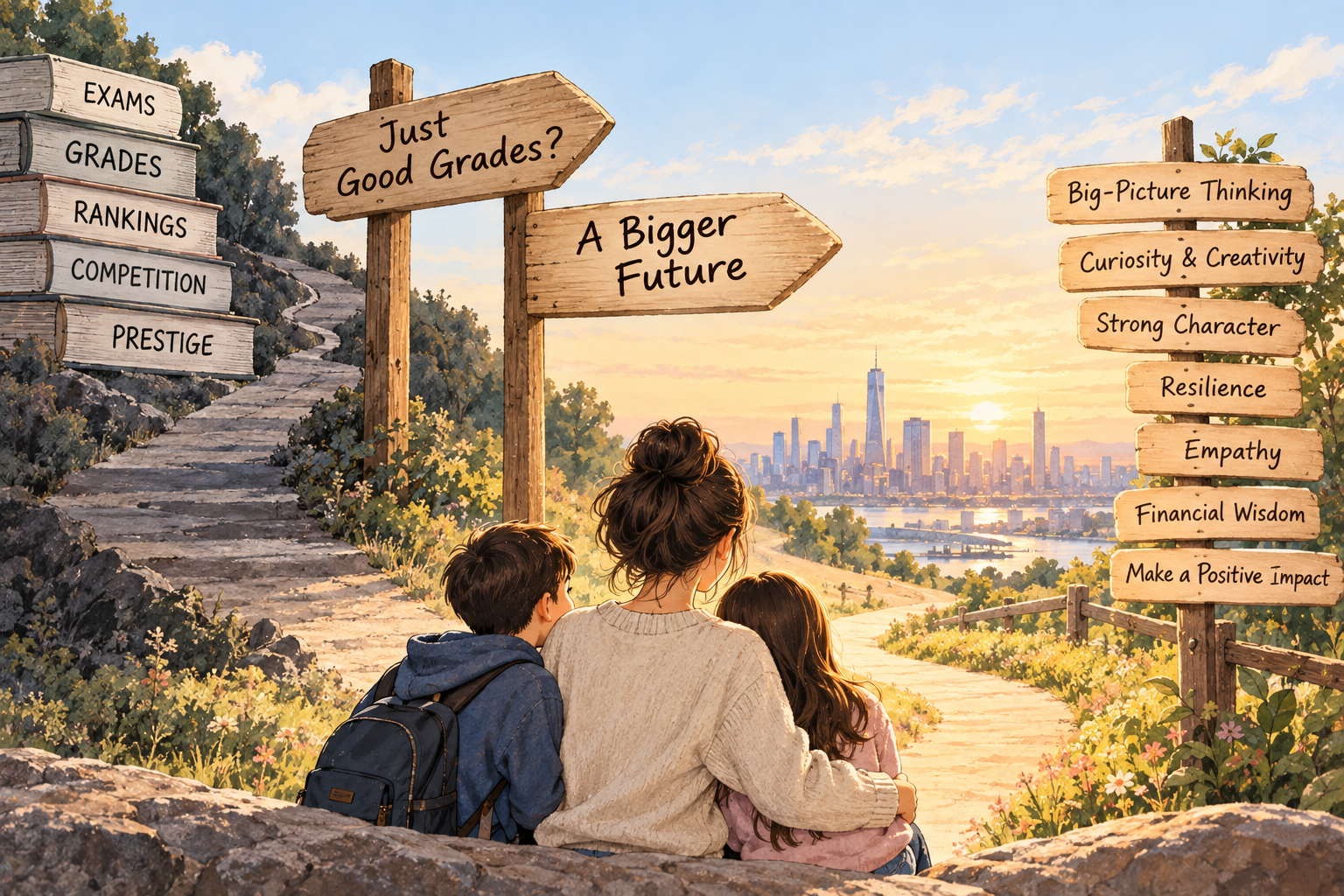
Why I’m teaching my children responsibility, resilience, and independent thinking in the AI era—and why these lessons may be more valuable than money.
What If the Best Investment Isn’t Financial?
I spend a lot of time thinking about money.
How to save more, invest wisely, prepare for retirement, and build financial security for my family.
Like many parents, I want to give my children a comfortable future. I want them to have opportunities, receive a good education, and hopefully avoid some of the financial struggles that many adults experience.
But lately, I’ve been thinking about something different.
What if the most valuable investment I can make in my children’s future has nothing to do with money?
I can save for their college education.
I can invest money for them.
I can even leave them an inheritance someday.
But what happens if they don’t know how to make good decisions?
What if they’re afraid to take risks, unable to handle failure, or constantly waiting for someone else to tell them what to do?
Will the money I leave them really help?
These questions have been on my mind for a long time.
And they’ve made me reconsider what it actually means to prepare my children for a successful future.
1. Are Good Grades Enough to Prepare Our Children for Life?
As parents, we spend so much time worrying about school.
Did they finish their homework?
How did they do on their math test?
Are they reading enough?
Are they keeping up with their classmates?
I ask these questions, too.
Of course, education matters. Reading, mathematics, science, and writing provide the foundation children need to understand the world.
But sometimes I wonder whether we’re focusing so much on grades that we’re forgetting the bigger picture.
Getting good grades and becoming a capable adult are not necessarily the same thing.
A child might be excellent at memorizing information but struggle to solve an unfamiliar problem.
Another child might not always receive the highest grades but have incredible creativity, curiosity, and determination.
Who will be more successful 20 years from now?
We don’t know.
And with artificial intelligence changing how people work, I think this question is becoming increasingly important.
2. In the AI Era, What Will Make Our Children Valuable?
When I was growing up, having knowledge was a major advantage.
People who could remember information, solve problems quickly, and perform well on exams often had more opportunities.
But today, AI can answer questions, write computer code, analyze information, and complete many tasks in seconds.
By the time our children enter the workforce, technology may have changed many careers we currently consider stable.
That doesn’t mean school is becoming irrelevant.
In fact, children still need strong academic foundations to understand information, recognize mistakes, and use technology responsibly.
But I believe they’ll need something more.
They’ll need to know how to ask meaningful questions.
How to recognize opportunities.
How to solve problems that don’t have obvious answers.
How to work with people.
And how to understand the direction society is moving.
I don’t want my children to simply compete with technology. I want them to learn how to use technology to create something valuable.
That requires more than memorizing information for an exam.
It requires independent thinking, curiosity, creativity, and judgment.
3. First, I Want to Raise Good Human Beings
Before financial success, academic achievement, or an impressive career, there’s something I value even more.
Character.
I want my children to become people who respect others.
People who consider how their words and actions affect someone else.
People who can disagree without being disrespectful.
And people who know how to express their own feelings.
I don’t want them to believe that being kind means always agreeing with others.
They should be able to say:
“I understand how you feel, but I see things differently.”
“That hurt my feelings.”
“I made a mistake, and I’m sorry.”
“I don’t think that’s right.”
These may seem like simple communication skills, but I believe they’ll matter throughout their lives.
Whether my children become business owners, employees, parents, or leaders, they’ll need to understand people.
And in a world where technology can perform more tasks, the ability to build trust, communicate clearly, and care about others may become even more valuable.
What Can I Do as a Parent?
I’ve realized that children learn from how we behave.
If I want my children to speak respectfully, I need to speak respectfully to them.
If I want them to admit mistakes, I need to acknowledge my own.
If I want them to understand other people’s feelings, I need to listen to theirs.
It’s easy to tell children what kind of people they should become.
It’s much harder to demonstrate those values consistently.
And that’s something I’m still working on.
4. Responsibility Is the Beginning of Financial Independence
When I think about raising financially independent children, I don’t immediately think about teaching them how to buy stocks.
I think about responsibility.
Can they wake up and get ready for school on time?
Can they remember their homework without being reminded constantly?
Can they organize their schedule?
Can they finish something they promised to do?
These may seem like small childhood responsibilities.
But I believe they’re connected to much bigger skills.
A child who learns to manage homework is also practicing how to manage time.
A child who saves money for something they want is learning patience.
A child who completes an unpleasant task is developing discipline.
And a child who understands the consequences of their choices is learning accountability.
These are the same abilities adults need to manage their finances.
Small Habits Can Become Important Life Skills
| Childhood Habit | Skill for Adult Life |
|---|---|
| Completing homework independently | Managing responsibilities |
| Arriving at school on time | Respecting time and commitments |
| Saving allowance for something meaningful | Delayed gratification |
| Planning activities and assignments | Prioritizing time and resources |
| Taking care of personal belongings | Respecting what they own |
| Finishing a difficult project | Persistence and discipline |
I don’t expect my children to master these skills overnight.
They’re still children.
They need reminders, encouragement, and room to make mistakes.
But I want to gradually give them more responsibility instead of managing every detail of their lives.
My goal isn’t to raise children who always follow my instructions. It’s to raise children who eventually don’t need my instructions.
5. I Want My Children to Think Like Investors
When I say I want my children to think like investors, I’m not talking about teaching them to trade stocks at age 10.
I’m talking about developing a mindset.
Successful long-term investing often requires patience, thoughtful decision-making, an understanding of risk, and the ability to learn from mistakes.
I believe those same qualities are valuable in everyday life.
Understanding Time
Time is one of the few things we can’t earn back.
I want my children to understand that how they spend their time matters.
That doesn’t mean every minute needs to be productive.
Playing, resting, and spending time with friends are important parts of childhood.
But I want them to learn the difference between spending time intentionally and simply letting time pass.
Understanding Risk
Every decision involves some uncertainty.
Trying a new sport.
Joining an unfamiliar activity.
Speaking up in class.
Starting a small project.
Sometimes things work out. Sometimes they don’t.
I want my children to learn how to consider risks rather than automatically avoid them.
Because avoiding every possibility of failure can also mean missing opportunities.
Understanding Patience
We live in a world where almost everything is available immediately.
Information, entertainment, shopping, and communication are only a few clicks away.
But meaningful achievements often take time.
Learning an instrument, developing a skill, building a friendship, or saving money requires consistency.
I want my children to experience the satisfaction of working toward something over months or years.
Recognizing Opportunities
Instead of only asking, “What job do you want when you grow up?” I want to ask:
“What problems do you notice around you?”
“How could you make something better?”
“What would you create if you could?”
These questions encourage children to see themselves as people who can contribute ideas rather than simply follow an existing path.
To me, an investment mindset is about making thoughtful decisions today that create more possibilities tomorrow.
6. I Don’t Want Them to Be Afraid of Failure
This may be one of the hardest lessons for me to teach.
As a parent, I naturally want to protect my children.
If they forget something, I want to remind them.
If they struggle with homework, I want to help.
If they feel disappointed, I want to make them feel better.
But I’m beginning to realize that constantly solving their problems may prevent them from learning how to solve problems themselves.
Life won’t always go according to plan.
They may fail an exam.
Lose a competition.
Get rejected from a program.
Make a poor financial decision.
Or choose a career path that doesn’t work out.
I can’t prevent every disappointment.
But I can help them develop the confidence to recover.
Instead of focusing only on the result, I want to ask:
“What did you learn?”
“What would you do differently next time?”
“What could you try now?”
I want them to understand that making a mistake doesn’t make them a failure.
It gives them information they didn’t have before.
A strong mindset isn’t believing you’ll always succeed. It’s believing you can move forward even when you don’t.
And that ability can be valuable in careers, relationships, business, and financial decisions.
7. Teaching Children to See the Bigger Picture
This is something I think about often.
I don’t want my children to become so focused on small tasks that they never question why those tasks matter.
I want them to understand how the world works.
Why do certain businesses succeed?
Why do some jobs disappear?
Why do housing prices rise?
How does technology change people’s lives?
Why do some people recognize opportunities before others?
These aren’t necessarily questions children need to answer perfectly.
But I want them to become curious enough to ask.
For example, when we visit a restaurant, we can talk about why customers choose that restaurant.
When we see a new technology, we can discuss what problem it solves.
When we hear about a company becoming successful, we can explore what made its product useful.
When we talk about money, we can discuss why prices change and why families make different financial decisions.
These everyday conversations can introduce children to economics, business, technology, and society without turning childhood into another classroom.
I want them to understand the world they’re growing up in—not just prepare for the next exam.
8. Creativity Is a Skill Worth Developing
When people think about creativity, they often imagine drawing, painting, or music.
But creativity is much broader.
It’s finding a different way to solve a problem.
Connecting ideas that seem unrelated.
Imagining something that doesn’t exist yet.
Or recognizing a need that other people haven’t noticed.
I believe these abilities will be increasingly useful as technology continues to develop.
But creativity needs space.
If every hour of a child’s day is scheduled, when do they have time to explore their own ideas?
If adults always provide the answers, when do children practice thinking independently?
I want to give my children opportunities to build things, invent games, experiment, write stories, and create projects simply because they’re interested.
Not every activity needs to produce an award.
Not every hobby needs to become a future career.
Sometimes the value comes from discovering what they’re capable of imagining.
9. What I’m Trying to Practice at Home
I have plenty of ideas about the kind of parent I want to be.
Putting those ideas into practice is another story.
There are days when I’m tired.
Days when I repeat myself too many times.
Days when it’s easier to tell my children what to do than patiently explain why.
I know I won’t always get it right.
But I’m trying to focus on a few habits.
| What I Want to Teach | What I’m Trying to Do |
|---|---|
| Kindness and respect | Listen to their feelings and model respectful communication |
| Responsibility | Give them age-appropriate tasks they can manage independently |
| Resilience | Help them learn from mistakes without making failure frightening |
| Financial discipline | Talk about saving, spending, and making thoughtful choices |
| Creativity | Encourage projects without expecting perfect results |
| Independent thinking | Ask what they think before offering my opinion |
| Big-picture thinking | Discuss how everyday events connect to the wider world |
None of these ideas requires expensive classes or special equipment.
Often, they begin with ordinary conversations at home.
And I think consistency matters more than trying to teach everything at once.
10. The Difference Between Leaving Children Money and Teaching Them to Build Wealth
As parents, many of us hope to leave something behind for our children.
Maybe it’s a home.
An investment account.
Money for college.
Or an inheritance.
There’s nothing wrong with wanting to provide financial security.
I want that for my children, too.
But I also think about what happens after they receive that money.
Will they understand how to manage it?
Will they recognize the difference between an asset and an unnecessary expense?
Will they know how to evaluate risks?
Will they have the confidence to make independent decisions?
And will they understand that money is a tool rather than the purpose of life?
I can spend decades building financial assets for my children.
But if I don’t also help them develop judgment, responsibility, and values, I may be leaving them only part of what they need.
Two Different Ways to Invest in a Child’s Future
| Financial Investment | Personal Development Investment |
|---|---|
| College savings | Curiosity and a love of learning |
| Retirement or investment accounts | Patience and long-term thinking |
| Inheritance | Financial responsibility |
| Paying for education | Independent problem-solving |
| Providing opportunities | Confidence to pursue opportunities |
| Building family wealth | Character and strong values |
Both types of investment matter.
Money can create opportunities.
But personal qualities help children decide what to do with those opportunities.
I don’t want to choose between giving my children financial security and teaching them independence. I want to work toward both.
11. Parenting Is the Longest Investment I’ll Ever Make
When we invest in the stock market, we often talk about compound growth.
Small amounts invested consistently over many years can grow into something meaningful.
Sometimes I think parenting has a similar long-term nature.
One conversation may not change a child’s behavior.
One reminder may not create responsibility.
One disappointment may not immediately build resilience.
But perhaps the small lessons we repeat over many years gradually become part of who our children are.
The way we listen.
The way we respond to mistakes.
The way we encourage curiosity.
The way we demonstrate responsibility.
And the way we show love.
Of course, children aren’t investments in the financial sense.
They are individuals with their own personalities, interests, and dreams.
There’s no guaranteed outcome, and parenting isn’t something we can measure with a return-on-investment calculator.
My job isn’t to control every part of their future.
It’s to provide a strong foundation and help them develop the confidence to make their own choices.
Final Thoughts: What Kind of Adults Am I Trying to Raise?
Sometimes I imagine my children 20 years from now.
I don’t know what careers they’ll choose.
I don’t know what technology they’ll use.
And I don’t know what the economy will look like.
Maybe some of today’s most desirable jobs won’t exist anymore.
Maybe entirely new opportunities will appear.
But I know what I hope for.
I want my children to become people who can think independently.
People who aren’t afraid to try something difficult.
People who understand the value of time and money.
People who take responsibility for their choices.
People who can recognize opportunities without compromising their values.
And above all, people who treat others with kindness and respect.
Of course, I want them to do well in school.
I want them to have opportunities and financial security.
But I don’t want their childhood to become a competition for grades, awards, and achievements.
I want to prepare them for life, not just the next exam.
And I know I’ll make mistakes along the way.
After all, this is my first time being a parent, too.
I’m learning how to guide my children while they’re learning how to become themselves.
Maybe that’s what makes parenting so challenging and meaningful.
We’re growing together.
I can leave my children money. But the greatest gift I hope to give them is the ability to build a meaningful, independent life of their own.
By Irene | Money Bloom Daily
Author’s note: This article reflects my personal experience and thoughts about parenting, education, and financial independence. Every child develops differently, and there is no single formula for raising successful or financially independent children.
Leave a Reply