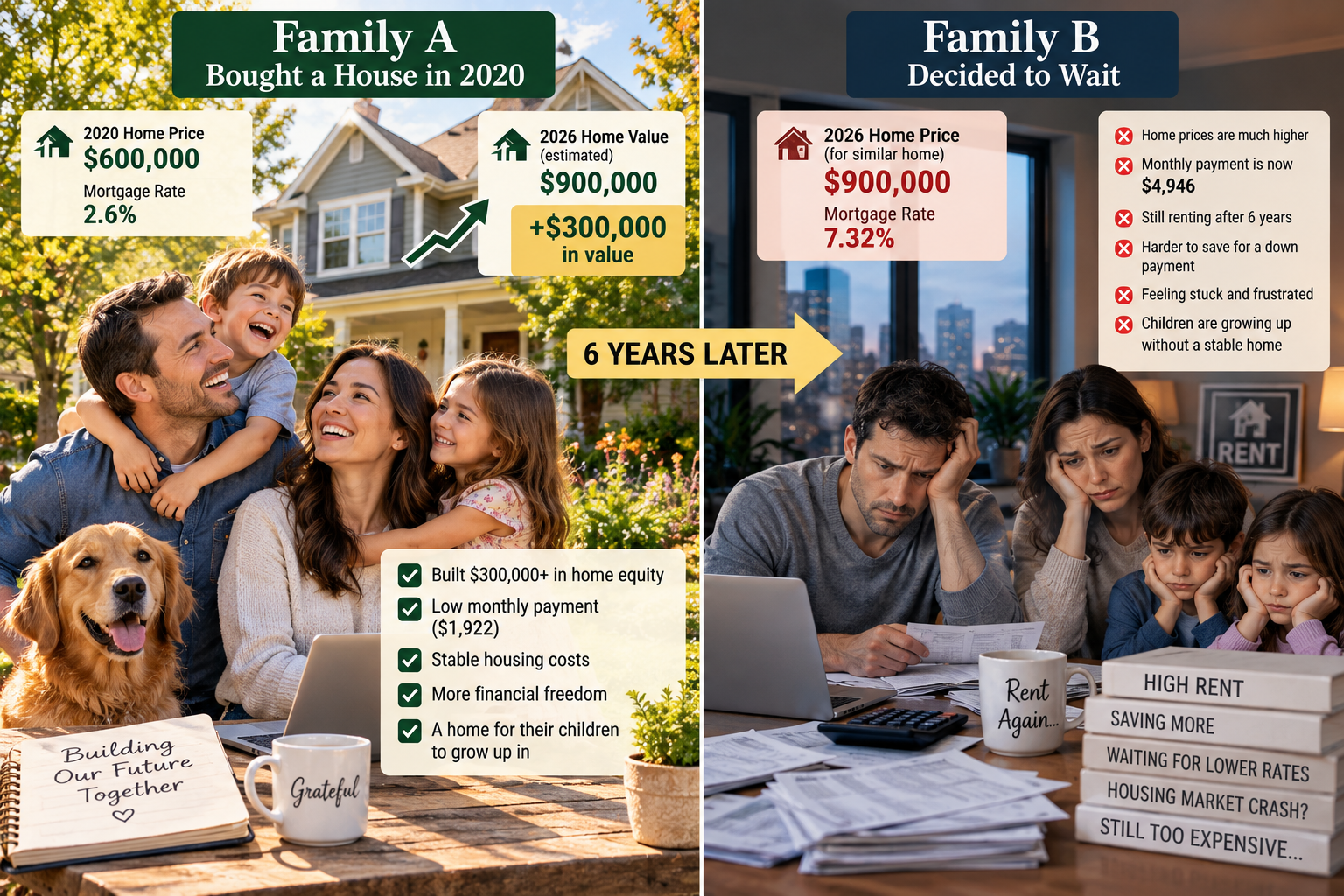
In 2020, two families were ready to buy a home. One purchased a house with a 2.6% mortgage rate. The other decided to wait for housing prices to fall. Six years later, their financial situations look completely different.
Sometimes, one financial decision can change your family’s future.
Imagine two married couples living in New York.
They earn similar salaries, have similar savings, and dream of buying a house where they can raise their children.
It’s 2020.
COVID-19 has changed everything. Businesses are closing, people are losing jobs, and nobody knows what will happen to the economy.
Both couples have enough money for a down payment.
But they make different decisions.
Family A decides to buy a house.
Mortgage rates are historically low, and they find a home they can afford. They lock in a 2.6% fixed mortgage rate.
Family B decides to wait.
They’ve been reading about the possibility of a housing market crash. Home prices seem expensive, and buying during a pandemic feels risky.
They decide to save more money and wait for prices to fall.
Their decision seems reasonable.
After all, who wants to buy a house right before a market crash?
But six years later, something unexpected has happened.
Family A has gained substantial home equity.
Family B has more savings, but buying the same type of house has become much more expensive.
Let’s look at how this happened—and what families can learn from it.
1. What Happened to the Two Families?
Let’s use a simplified example based on a home purchased in 2020.
Assume both families originally wanted to buy a $600,000 house.
Family A purchased the home with a 20% down payment and a 2.6% fixed mortgage.
Family B waited.
By 2026, imagine a comparable house costs $900,000.
Buying in 2020 vs. Buying in 2026
| Family A: Bought in 2020 | Family B: Buying in 2026 | |
|---|---|---|
| Home price | $600,000 | $900,000 |
| Down payment (20%) | $120,000 | $180,000 |
| Mortgage amount | $480,000 | $720,000 |
| Mortgage interest rate | 2.6% | 7.32% |
| Monthly mortgage payment | $1,922 | $4,946 |
| Annual mortgage payments | $23,064 | $59,352 |
Payments are approximate principal and interest only, based on a 30-year fixed mortgage. They exclude property taxes, insurance, maintenance, closing costs, and other expenses. The home prices are illustrative, not the price history of a specific property.
Look at the difference.
Family B would pay approximately $3,024 more every month to buy a comparable home.
That’s more than $36,000 extra per year in mortgage payments.
Even though both families originally earned similar salaries, their housing costs are now dramatically different.
And there’s another important difference.
2. Family A Built Wealth While Living in Their Home
Family A purchased their home for $600,000.
Six years later, we’re assuming it’s worth $900,000.
That’s a $300,000 increase in home value.
They didn’t need to buy and sell stocks every day.
They didn’t need to start a business.
They simply lived in their house while its market value increased.
But there’s more.
Every monthly mortgage payment also reduced a portion of their loan balance.
After approximately six years, their original $480,000 mortgage would have fallen to about $411,000, assuming regular payments and no refinancing.
Here’s what their home equity might look like.
| Family A’s Home Equity | Amount |
|---|---|
| Estimated home value in 2026 | $900,000 |
| Remaining mortgage | −$411,000 |
| Estimated home equity | $489,000 |
Family A originally invested $120,000 as a down payment.
Now they have approximately $489,000 in home equity.
That’s an increase of about $369,000 in equity before accounting for closing costs, maintenance, taxes, insurance, and other ownership expenses.
This doesn’t mean they earned $369,000 in cash profit.
They would need to sell or borrow against the home to access much of that equity, and selling involves expenses.
Still, the increase in wealth can be significant.
Meanwhile, Family B is facing a very different situation.
3. What Happened to the Family That Waited?
Family B didn’t make a foolish decision.
They were trying to be responsible.
They wanted to avoid buying at the wrong time.
They wanted a larger down payment and more financial security.
But something happened while they waited.
Home prices increased, and mortgage rates rose sharply.
Even if Family B saved another $60,000, their larger down payment might not be enough to offset the higher purchase price and borrowing costs.
And if they continued renting, they would also have paid rent during those six years.
Of course, Family A had expenses too, including property taxes, repairs, insurance, and mortgage interest.
A fair comparison would include both families’ complete housing expenses and what Family B did with its savings.
For example, if Family B invested its down payment in the stock market and earned strong returns, its financial position might be better than this simple comparison suggests.
But the central lesson remains:
Waiting has a financial cost when prices and borrowing costs rise faster than your savings.
4. Why Did Home Prices Rise Instead of Crash?
During COVID-19, many people expected the housing market to collapse.
Instead, several forces pushed prices higher.
Mortgage rates dropped to historically low levels, making monthly payments more affordable.
Some households wanted larger homes as remote work became more common.
At the same time, the supply of available homes was limited in many areas.
More buyers competing for fewer homes helped drive prices higher.
Later, when mortgage rates increased, another problem developed.
Homeowners who had locked in rates near 3% had little financial incentive to sell and take on a much more expensive mortgage.
That helped keep housing inventory tight in some markets.
On Long Island, home prices have continued to show strength. Federal Housing Finance Agency data showed that prices in the Nassau–Suffolk area increased approximately 47.7% over the five years ending in the second quarter of 2026.
That doesn’t mean every individual home appreciated by the same amount, but it helps explain why many families who bought several years ago now have substantial equity.
5. How Important Is Mortgage Timing?
When buying a home, people usually focus on the purchase price.
But the interest rate can be just as important.
Imagine buying a $600,000 home with a 20% down payment.
Your mortgage would be $480,000.
Here’s how different interest rates affect your monthly payment.
Same House, Different Mortgage Rates
| Mortgage Rate | Monthly Payment |
|---|---|
| 2.6% | $1,922 |
| 4% | $2,292 |
| 5% | $2,577 |
| 6% | $2,878 |
| 7.32% | $3,297 |
Approximate monthly principal and interest on a $480,000, 30-year fixed mortgage.
The house is exactly the same.
The down payment is exactly the same.
But at 7.32%, the monthly payment is approximately $1,375 higher than at 2.6%.
That’s why people who locked in low mortgage rates have such a significant advantage today.
They have relatively low monthly housing payments, even if their homes have increased substantially in value.
6. Is It Still a Good Time to Buy a House in 2026?
This is the question many families are asking.
As of October 22, 2026, the average 30-year fixed mortgage rate was approximately 7.32%, according to Freddie Mac.
That’s much higher than the rates available during 2020 and 2021.
But higher interest rates don’t automatically mean buying a home is a bad decision.
The answer depends on your finances, local housing prices, and how long you plan to stay.
Buying Now vs. Waiting
| Buying Now May Make Sense If… | Waiting May Make Sense If… |
|---|---|
| You can comfortably afford the monthly payment | The payment would stretch your budget |
| You plan to stay for many years | You may move within a few years |
| You have a stable income | Your employment situation is uncertain |
| You have an emergency fund after closing | Buying would use nearly all your savings |
| The price is reasonable for your local market | Comparable homes are significantly overpriced |
One mistake I would avoid is assuming that mortgage rates will definitely fall next year.
Nobody knows exactly when rates will decline.
And even if rates fall, more buyers could return to the market, increasing competition for homes.
On the other hand, prices could decline in some areas.
Buying a house should depend on whether you can afford it today—not whether you hope to refinance tomorrow.
7. What Can Families Who Missed the Low-Interest Opportunity Do?
If you didn’t buy a home in 2020 or 2021, it’s understandable to feel frustrated.
But that opportunity is already in the past.
The more useful question is:
What can you do with the money and opportunities available today?
Here are five practical strategies.
Strategy 1: Focus on the Monthly Payment, Not Just the House Price
Instead of asking, “How much house can the bank approve me for?” ask:
“How much can my family comfortably pay every month?”
Include property taxes, insurance, utilities, repairs, and other ownership expenses.
For example, a lender might approve you for a $900,000 home.
But if the monthly expenses leave you unable to save for retirement or handle emergencies, that home may not be affordable for your family.
Buying a less expensive house could give you more financial freedom.
Strategy 2: Look for Opportunities to Negotiate
Higher mortgage rates have made buying difficult for many households.
But fewer qualified buyers can sometimes create opportunities.
In September 2026, the national housing market had approximately 4.8 months of available supply, according to the National Association of Realtors.
Some sellers may be more willing to negotiate, especially if their homes have been listed for a long time.
Instead of focusing only on the asking price, consider negotiating for a lower purchase price, repairs, or closing-cost assistance.
A seller credit might also help pay for a temporary or permanent mortgage-rate buydown.
Just make sure you understand the costs and whether the savings justify them.
Strategy 3: Increase Your Down Payment—But Keep Emergency Savings
A larger down payment reduces the amount you need to borrow.
At today’s higher interest rates, borrowing less can make a meaningful difference.
However, I wouldn’t recommend putting every dollar into the down payment.
Homeownership comes with unexpected expenses.
A broken heating system, roof repair, or plumbing problem can cost thousands of dollars.
Keeping emergency savings is just as important as getting into the house.
Strategy 4: Don’t Leave Your House Savings Without a Plan
If you expect to buy within the next year or two, consider keeping your down payment in relatively stable, accessible options such as a high-yield savings account, short-term Treasury bills, or an appropriate CD.
These options can earn interest while helping protect money you’ll need soon.
If your home-buying goal is five or more years away, you might consider investing some savings for longer-term growth, depending on your risk tolerance.
However, stocks can lose value, sometimes significantly.
Money you need for a near-term down payment generally shouldn’t depend on the stock market performing well.
Strategy 5: Consider a Starter Home
Your first home doesn’t need to be your dream home.
A smaller house, townhouse, condo, or co-op may provide a more affordable way to enter the market.
But don’t assume buying any property is better than renting.
Consider maintenance fees, property taxes, transaction costs, and how long you expect to stay.
Sometimes a modest home is a smart first step.
Other times, continuing to rent and invest is financially reasonable.
The goal isn’t simply to own property.
The goal is to improve your family’s long-term financial position.
8. Should You Wait for a Housing Market Crash?
I understand why people want to wait.
Nobody wants to buy a $900,000 house and watch its value fall to $750,000.
But waiting for a crash can become a habit.
You wait because prices seem too high.
Then you wait because interest rates are too high.
Then you wait because you think prices might fall next year.
Before you know it, several years have passed.
The challenge is that nobody can consistently predict the perfect time to buy.
And a housing crash isn’t necessarily good news for buyers.
A major decline in home prices can happen alongside job losses, tighter lending standards, or economic uncertainty.
That could make buying difficult even if houses become cheaper.
Instead of trying to predict the bottom of the market, focus on what you can control.
Can you afford the payment?
Is your income stable?
Will you stay long enough to justify the buying and selling costs?
Do you have enough savings left after purchasing?
Those questions are more useful than trying to guess next year’s home prices.
9. What I Learned From These Two Families
When I think about these two families, I don’t believe Family A was necessarily smarter than Family B.
Family A took a risk during an uncertain time.
Family B tried to protect its savings.
Both decisions made sense based on what they knew.
The difference is that the housing market moved in a direction neither family could predict with certainty.
Family A benefited from rising home prices and an unusually low fixed mortgage rate.
Family B missed that opportunity.
But we shouldn’t turn this story into a rule that buying immediately is always the right decision.
Someone who purchased at the peak of a different housing market might have experienced falling home values instead.
And someone who waited while investing consistently could have built substantial wealth outside real estate.
The real lesson isn’t that you should always buy a house. It’s that waiting for certainty can sometimes mean missing an opportunity.
Final Thoughts: You Can’t Change Yesterday’s Market
It’s easy to look back at 2020 and wish you had purchased a home.
A $600,000 house with a 2.6% mortgage sounds like an incredible opportunity today.
But in 2020, nobody knew exactly what would happen.
The same is true in 2026.
We don’t know whether home prices will rise, fall, or remain flat over the next several years.
What we can do is make decisions based on our finances rather than fear.
If buying a home today would create too much financial pressure, there’s nothing wrong with waiting.
Use that time to save, invest appropriately, improve your credit, and prepare.
But if you find a reasonably priced home that fits your family’s needs and you can comfortably afford it, don’t automatically reject the opportunity because you’re waiting for the perfect market.
The best time to buy a house isn’t necessarily when prices or interest rates are lowest. It’s when the purchase makes financial sense for your family.
And sometimes, the most expensive decision isn’t buying at the wrong time.
It’s spending years waiting for a perfect moment that never arrives.
By Irene | Money Bloom Daily
Disclaimer: This article is for educational purposes only and does not constitute personalized financial advice. The two families and their home prices are hypothetical examples. Housing prices, mortgage rates, taxes, and ownership costs vary by location and individual circumstances. Historical appreciation does not guarantee future returns.
Leave a Reply